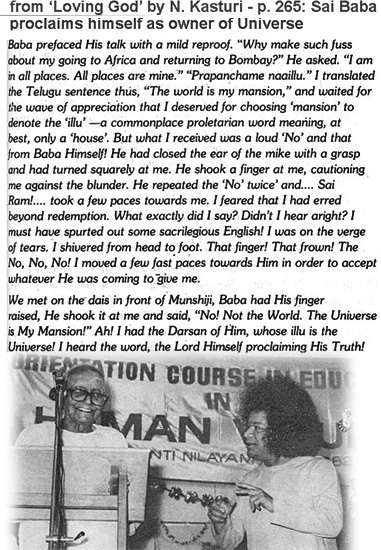
One cannot conceive of more tremendous claims, however much one may try! Nor one which conflicts more with any ' universal spirituality' This implies strongly that he is really the one whom all should follow, even while denying that he wishes everyone to worship him. This cannot be other than a highly contentious religious dogma... a most disrupting and tradition-ignoring social and political idea. It is about as repugnant to other mainstream faiths as can be. It is the stuff of which inquisitions and holy jihads have been made. Consider also how badly this sits with orthodox Christians who insist that Jesus Christ was God's incarnate son and is the only way to God, while all other worshippers are misguided, even 'unredeemed', 'lost souls' and so on.
For example, an English lady who visited Sathya Sai Baba twice and had an interview in 1986, and who has since joined the Sufi movement, wrote to me about the accusations of pedophilia by Sathya Sai Baba: "I have always had a problem with the Avatar concept, as we have discussed several times - it is not in my repertoire of concepts. I worship God, and I cannot worship a human being. I have great respect, and wish to learn from the God-realized, whether they reach this realization during life, or are born in this state. For me, every human is fallible and can make mistakes." Sathya Sai Baba virtually admits this himself sometimes, as in: "God assumes a role in the dharma of the world in human form. He has to behave as a human being only. This should be clearly understood by all." (Sathya Sai Speaks - Vol 26. New ed., p. 229f). An English friend who has visited Sathya Sai Baba twice and had an interview in 1986, wrote to me recently after hearing about the accusations of pederasty, "I have always had a problem with the Avatar concept, as we have discussed several times - it is not in my repertoire of concepts. I worship God, and I cannot worship a human being. I have great respect, and wish to learn from the God-realized, whether they reach this realization during life, or are born in this state. For me, every human is fallible and can make mistakes."
Divisive exclusivity under cover of alleged 'universality'
The way the Sathya Sai Baba doctrine turns out in practice in the various Sathya Sai organizations around the world indicates some of the fundamental contradictions inherent in the claim of avatarhood combined with an ideal of universal spirituality. (See my extensive participation/observation-based sociological analysis of the Sathya Sai Organisation) The organisation has to be steered centrally, and - though Westerners are given top positions - it is dominated by Indians and Hindus practices and norms. It therefore invariably takes on the character of Hindu religion, however many efforts are made to limit outright idol worship andtake account of persons of other beliefs and different spiritual inclinations.
Sai Baba has preached with extreme insistence and utmost repetitively that all religions have the same essential, good values. That they mostly share some of the same values is acceptable, but it is not possible reasonably to show that this is so across the board. However, interestingly, he has endorsed the follower Irani Ma, who published in a book officially sold at his ashram, that Muslims will not recognise him as they "will be so bad that they will not find him"
The heads of the main religions are often doctrinally at loggerheads on many issues, from peace vs. war an human violence to animal killing, authenticity of scriptures to means of propagation, from which figures are divine and which not. No variant of Islam allows for any incarnation of God either living or dead (yet Sathya Sai Baba claims to be the living Godhead, deity of all deities). For Muslims, it is heresy even to make an image of God. The present Pope Benedict, leader of over 600 million Catholics, rejects as heretical all religious doctrines which do not accept the primacy of Jesus Christ. The Pope asserts that eternal damnation in hell is a reality, which is in contradiction to Sai Baba's view. Islam, Judaism and Christianity reject that God can be represented in any idol (while Hinduism and Sai Baba accept thousands of deities and idols of all kinds). Judaism awaits a Messiah, but Sathya Sai Baba most evidently does not fulfil their conditions, so Judaism does not proclaim him as their Messiah. Buddhism, in the main, rejects the whole idea of a God Creator of the Universe, as Sai Baba claims he is. What Sathya Sai Baba also asserts again and again is that all the religions are ignorant of God, who is unknowable (i.e. yet he repeatedly boasts he knows it all, being the Divinity itself).
Sai Baba holds that all religions worship the same God. This is a facile and untenable statement… for even the different mainstream religions worship each their own peculiar and theologically-determined ideas of God. The word God is virtually what is most universal about this imagined entity. misleading everyone without analytic powers to think there is one and the same entity behind the word. Whether any being exists which fits with one or other of these often distinctly different ideas is itself, of course, beyond any proof. That all people worship the same god is figuratively equivalent to saying that all cows which are black at night are the same cow.
Some religions posit God as creator of the universe, others do not accept God created the universe (Official Catholic doctrine today!), and many cannot accept that a human-like entity or any other entity could create the universe, but that it was self-created. Most Buddhist sects reject any God creator, but admit only of a supposedly fully realised human being as a Buddha.
There are thousands of ideas of deities, gods, goddesses and powers worshipped by every variety of tribe, sub-culture, sect and cult. None can show there is a sameness in all these, other than that the word God may be applied to them all willy-nilly. Sai Baba’s own childhood faith, namely, an eclectic hodge-podge, superstitious, multi-deity, idolatrous version of Hinduism was largely very ignorant of human history and other cultures. Yet he believes his 'teaching' to be ageless and the true origin and essential truth of all religion, no less! Thus, he has stated: “The Hindu religion knows no growth or decline. It belongs to all countries. It is acceptable to all people.” (Sathya Sai Speaks p. 172, Volume XX11)
False and conflict-making teaching about Jesus and Christianity
Christians worship God as Incarnate in Jesus. However, undercutting the entire Christian belief system, Sathya Sai Baba has explained - in his laughable 'Ba-ba' 1968 discourse - that he is the Father who sent Jesus to the earth. Yet he is confused about Jesus and his life, his disciples and events. This shows not only that he cannot possibly be omniscient, omnipotent and omnipresent, but that he would like to be seen as the undisputed master of all religions. His knowledge of other religions, their history and ideas, is extremely limited and often absurdely false, as has been show definitively from many of his published discourses. Of Jesus and Christianity he is particularly ill-informed (see here, and one striking example here). Judaism he confuses with Christianity, Islam he hardly mentions and never gives a single details from the Quran, the Sharea, Mohammed and so on.
He directs his criticism against the Christian churches, as follows:-
"At present there is a growing tendency among propagators of the Christian faith to cast aspersions on other religions. Money is being spent lavishly to spread Christianity. None of you should have any part in such activities. This type of propaganda does great harm tothe personality of Jesus." (Sathya Sai Speaks, Vol. 18 new ed., p. 192)
In short, he runs down propagators of the Christian faith for running down other faiths! He propagates his own 'faith' - that he is God Incarnate come to save humanity in countless discourses, and not least through world media like the Internet and his own radio station 'Radio Sai'. Having himself thoroughly demonstrated an unfathomable ignorance of much of the nature and history of Jesus, putting him down as lower than himself and other Indian avatars etc., has the audacity to speak of Christian propaganda that harms Jesus!
Sathya Sai Baba himself attributes to Jesus Christ having announced, if in cyptic symbols, God the Father's own "coming" - as Sathya Sai Baba, no less!:- See his first statement of this made in 1968 and published in his discourses:-
"There is one point that I cannot but bring to your special notice today. At the moment when Jesus was emerging in the Supreme Principle of Divinity, He communicated some news to his followers, which has been interpreted in a variety of ways by commentators and those who relish the piling of writings upon writings and meanings upon meanings, until it all swells up into a huge mess.
The statement itself has been manipulated and tangled into a conundrum. The statement of Christ is simple. "He who sent me among you will come again!", and He pointed to a lamb The lamb is merely a symbol, a sign. It stands for the Voice -- Ba-Ba; the announcement was of the Advent of Baba. "His Name will be Truth," Christ declared. Sathya means Truth. "He will wear a robe of red, a blood-red robe." (Here Baba pointed to the robe He was wearing!) He will be short with a crown (of hair). The lamb is the sign and symbol of Love. Christ did not declare that He will come again, He said, "He who made me will come again." That Ba-Ba is this Baba, and Sai, the short, curly-hair-crowned red-robed Baba is come. He is not only in this Form, but he is in every one of you, as the Dweller in the Heart. He is there, short, with a robe of the color of the blood that fills it."
(quoted from the discourse of Christmas 1973, and present in "Sai Baba, God Incarnate", by V.Kanu)"
One of Sai Baba's many extraordinary blunders about the Christian religion is his ignorance of the personal name of the betrayer of Jesus i.e. Judas. What singled this Judas out from the many Judases of his time? Anyone familiar with the Christian literature knows that he is referred to as Judas Iscariot. But Sathya Sai Baba refers to him as ‘Judas Simon’! The Sai Baba blunder is that:
“Judas Simon is well known today as the disciple who was treacherous…” Equally important, in Gospel materials, the betrayer of Jesus is referred to simply as ‘Judas’, or as ‘Judas Iscariot’, or as the son of a man named ‘Simon Iscariot’. Ancient materials do not recognize Judas Iscariot as ‘Judas Simon’, no do any informedstudents today. Another disciple of Jesus was named Peter Simon (see for example, Mark 14: 37) and it appears that Sai Baba has confused these names. This was not just a single slip of the [omniscient?] mind, because Sai Baba has also explained:
”Jesus Christ had twelve foremost disciples. Among the twelve only Judas Simon would injure Jesus, their teacher and spiritual savior.” [Sai Baba, quoted in An Eastern View of Jesus Christ, p. 111]
The most ridiculous and revealing statement by Sathya Sai Baba about Jesus is as follows:-
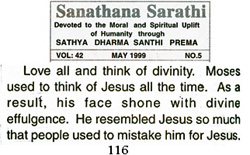
“Moses used to think of Jesus all the time. As a result, his face shone with divine effulgence. He resembled Jesus so much that people used to mistake him for Jesus.” (25.3.1999. Sanathana Sarathi Vol.42, #5,p.116)
Which people mistook Moses for Jesus, one wonders? So far no a single remaining Sathya Sai Baba follower has commented on this in any way…. and it is easy to see why!
Sai Baba about (St.) Paul and the closest devotees of Jesus:
"When it was ordered that all the devotees of Jesus should be crucified along with Him, even His closest devotees, Peter, Matthew, and Paul refused to identify themselves as His followers." (25.12.1998, Sanathana Sarathi Vol.42,#1,p.4)
Sai Baba on Romans and Jews:
"In the beginning even Romans were Jews, not Christians. It is only after the advent of Jesus that the term Christians came into use." (Discourse 24.11.1998)
The number of disciples was modified by Sathya Sai Baba too! "Similarly, among Christ’s eleven disciples differences developed and they fell apart. Only Mathew remained true to Jesus. He propagated the gospel. Peter was the first among Jesus’s disciples. But he denied Christ when the authorities questioned him."(7.09.1996. Sanathana Sarathi Vol.39, #10,p.269)
Sai Baba has alienated many Christians by his fraudulent 'mini-Bible' which he claimed to materialize at a Christmas celebration. See Sai Baba caught in cheating about the Christian Bible
The same applies to the provenly bogus claim that he materialized a piece of the true Cross with a replica of Christ as he actually looked at the moment of his passing. The crucifix given to John Hislop is described in the hagiographic book, My Baba and I by Dr. John Hislop, [1985: Birth Day Publishing, San Diego] has been one of the principal introductory books on Sathya Sai Baba. See Faked “miracle”: crucifix given by Sai Baba to Dr. Hislop
A further deceit to entrap Christians into his cult was the colour photo allegedly ‘transformed by Sai Baba miracle’ from the black-and-white version is based on the original photo of the Turin Shroud negative image (as posted by National Geographic) and is quite simply a copy of a painting by Ariel Aggemian, combined with the image on the Holy Shroud of Turin, scanned it from a three-dimensional card which had both images on it. See Sathya Sai Baba and the Turin shroud photos and this article
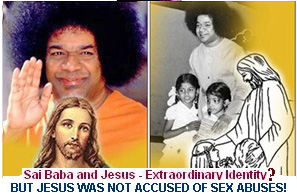
Last but not least, Sai Baba - who claims to be greater than Jesus Christ - in fact, the Father who sent Chist on his mission - differs from Jesus in having been involved in the cold-blooded execution of four young followers of his in his own bedroom in 1993 and in having been most widely and very credibly accused in sworn testimonies of sexual abuse of young men and boys - and reportedly on a very large scale.