SATHYA SAI BABA PROPHESIES AND RUMOURS ON ISLAM
FOLLOWERS OF ISLAM AND MOHAMMED MALIGNED BY THE SATHYA SAI
BABA MOVEMENT
To translate page: Use right click here - then 'Open page in new window' to translate
Sai Baba as King of the World? All this refers to undiscoverable, undocumented prophesies about Sathya Sai
Baba being the Muslims' Mehdi Moud or Mahdi (lit. 'the expected
one'). News of this was first announced by an elderly lady from Iran known
in the Sai movement as 'Irani Ma'. She claimed to have 'found by mysterious coincidence' in a marketplace in Iran a book, one of the many volumes of The Ocean of Light (Vol. 13, 14th edition). She claimed the book gave over 300 indicators that all point to Sathya Sai Baba as the prophesied 'Mehdi Moud' or 'Master of the World'. This book's title was given by Irani Ma as being one of the many volumes of 'The Ocean of Light' (Vol. 13, 14th edition), which was supposed to have been a recording of the sayings of Mohammed. Though the coming of the Mahdi or Mehdi (Great Master) is prophesied in ancient Islamic literature, no such prophesies as listed by Irani Ma were found either by Sunni or Shiite Islamic authorities who have been contacted on this matter. The only Islamic texts describing the Mehdi (or Mahdi) are in the Hadith literatur, supposed commentaries made by Mohammed, though collected 700 years after his death.
Brian Steel states: "Varying versions of the description of the expected Mahdi occur in several Muslim sources. One of these is Bihar al-Anwar ("Ocean of Light" - a metaphor for God), a voluminous work by a seventeenth century Iranian scholar, Muhammad Baqir al-Majlisi (1628-1699), which contains, among much else, the basic Shi'ite version of the Mahdi story." However, the text spoken of by Irani Ma and embroidered by others is apparently nowhere to be found in this work.
Irani Ma's conjectures were spread widely as fact by the doubtful
South African author R. Lowenberg in his fanciful and ill-researched book
'The Heart of Sai', and subsequently by the Peggy Mason in her highly inaccurate
and naive Sai Baba magazine and by numerous other such copyists. These prophesies contain allegations
about the moral degeneracy of Muslims in this age which
have become known throughout the Sathya Sai Baba movement, where not
one devotee has bothered to question their validity or research their supposed
source. This is from the popular Lowenberg version of the prophesy:-
"Mahomed
was asked if he (Mahomed) was "The Master of the World".
He said that he was not and that no prophet of God who had ever
come to the world has come with the power which he will come.
He went on to say that no prophet was like this Great Teacher, because
all the prophets were killed by the people, as their power had not
been sufficient to prevent their being killed, but that no power
will be able to conquer or kill "The Great Teacher".
The
disciples of Mahomed asked how they would find this great teacher.
Mahomed first gave "The Great Guide" five names. He called
Him "The Master of the World", "Master of Time",
"God's President", "A Great Part of God on the Ground"
and "God speaking and advising." He then went on to say
to his disciples, "You can never find him, because at that
time you will be so bad that you cannot recognise Him. Only a handful
will find Him. Christians and other people of other religions will
see Him, but Mussalmans will be so bad that they will not find him."
Mahomed
allegedly continued by giving about 300 signs that would clearly
refer to Sathya Sai Baba, his appearance, habits, actions etc. and
said this master would live until 95 to 96 years of age. Then he
went on, "In the last twenty years of his life, He will be
the "King of the whole world", "but at that time
only two thirds of the people of the world will believe in Him.
Mussalmans will only recognise Him nine years before his passing
from the world."
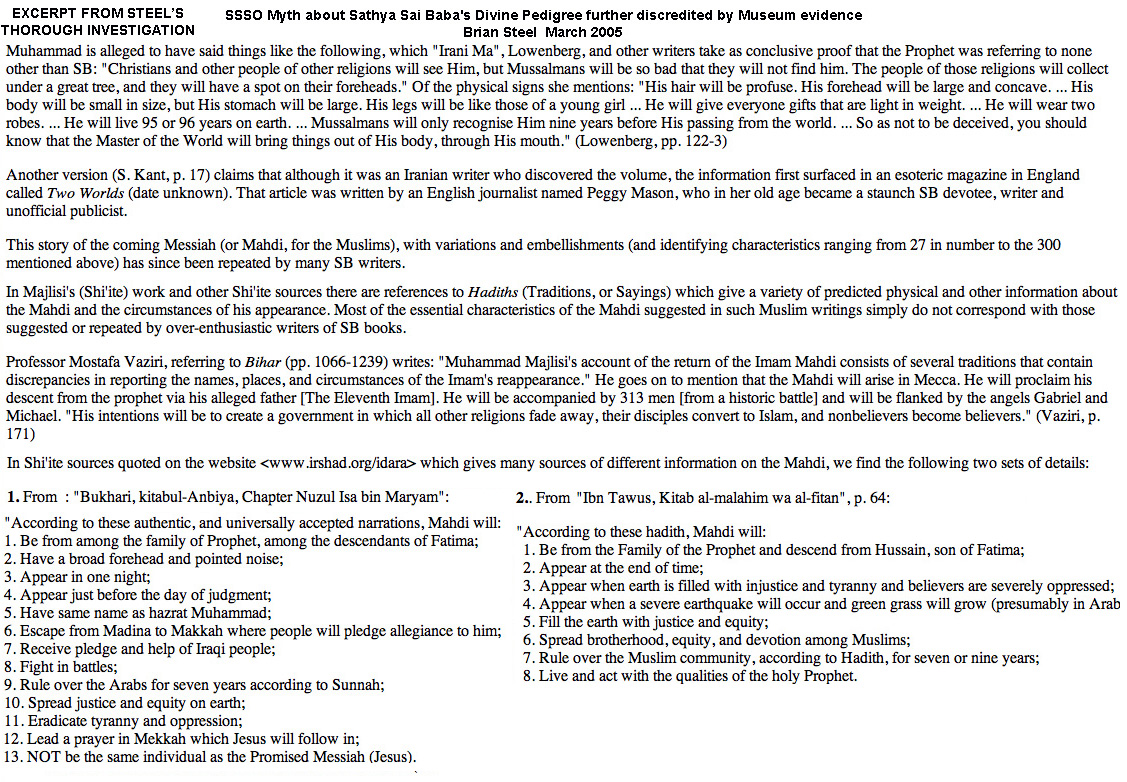
“Christians and other people of other religions will see Him, but Mussalmans will be so bad that they will not find him. The people of those religions will collect under a great tree, and they will have a spot on their foreheads.” Of the physical signs she mentions: “His hair will be profuse. His forehead will be large and concave. … His body will be small in size, but His stomach will be large. His legs will be like those of a young girl … He will give everyone gifts that are light in weight. … He will wear two robes. … He will live 95 or 96 years on earth. … Mussalmans will only recognise Him nine years before His passing from the world. … So as not to be deceived, you should know that the Master of the World will bring things out of His body, through His mouth.”
('The Heart of Sai' by R. Lowenberg,
India Book House PVT. Ltd. BOMBAY- 1981, p 122-3) |
No rebuttals from Sathya Sai Baba: That Sathya Sai Baba has never bothered to deny the authenticity of this demonstrates once again how he thrives on letting rumours spread unabated. On the claim that Sathya Sai Baba represents tolerance of other faiths and diversity of beliefs, one may ask why he has never repudiated the put-down of the vast majority of Muslims! But one can also easily guess the reasons for his liking the prophesies! In his follow-up book, Lowenberg tells how Sathya Sai blessed 'The Heart of Sai' book with the above quote on 15/7/1981.
"Baba came straight up to me and said, 'Books?' I said, 'Yes Swami, for you.' He said, 'Give.' and pointed to the Seva Dal man following Him. So at long last I had his blessing to go ahead and sell the book." (The Grace of Sai by R. Lowenberg. Bombay 1985, p. 31).
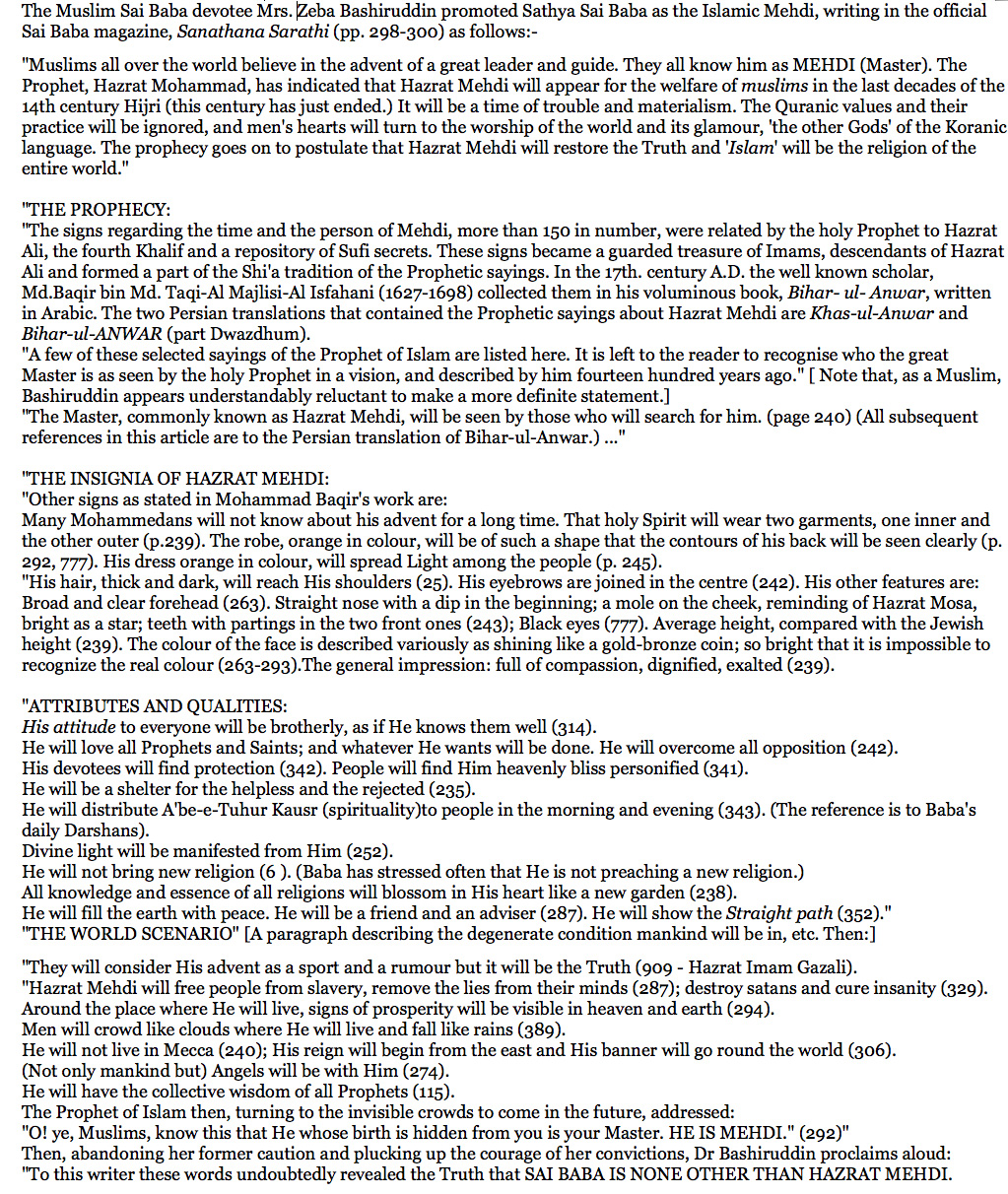
Further, when asked if he was the Mehdi by a Muslim devotee, Mrs. Zeba Bashiruddin, Sai Baba let her believe so, though he did not give her asked permission for printing the claim (wise, considering the repercussions it could have involved from fanatical Islamists). However, he virtually claim to be Allah since he pronounced he was God, the Creator of the Universe, the Father who sent Jesus and the Deity of all Deities. After much doubt and a process of fascination with Sai Baba, Bashiruddin eventually accepted that he was the Saviour (Mehdi Mou'd) of Islam. She wrote in the official Sai Baba magazine, Sanathana Sarathi (pp. 298-300 - see below)
Incidentally, inquiries made through a believing Muslim by the author to Sunni mullahs in Oslo only elicited the vague response that the Mehdi was apparently demonic, more like the Christian Anti-Christ who would appear or bring with him catastrophes. Despite this, belief in the coming Mehdi was powerful in the Sunni sects of the Middle East, as known especially well in the case of Sudan. The followers of Mohammed Ahmed, who was recognised as the returning, invincible Mahdi, fought the Egyptian-British armies at the battle of Omduran in 1898, in which Winston Churchill joined in a cavalry charge against them. Believing themselves magically protected against bullets, thousands were mown down by Maxim guns and the Mahdi was executed. (The Sunni tradition's authentication texts are listed at http://www.al-islam.org/encyclopedia/chapter2/2.html).
Sathya Sai Baba's claims of Godhood are a major blasphemy in Islam. The decisive, ultimate problem with the Sathya Sai Baba teaching for Muslims is that it is anchored very firmly in the specific Hindu doctrine of the God-avatar. Allah never takes on any form and only Allah is worthy of worship, according to the Koran. So Sathya Sai Baba's claim is, of course, exclusively a matter of belief and no more to 1.5 billion Muslims. Yet Sai Baba claims that he is the incarnation of the designer, creator and ruler of the entire universe, which is the same was what Muslims mean by Allah.
The Sathya Sai Baba 'package' has a highly doubtful wrapping which, once opened, confronts the recipient with a stark choice: either accept the whole of Sathya Sai Baba claims or you reject them all. If you try to reject any part of it, you thereby reject the basic assumption, that he is God the Father who can speak nothing but the truth. (Obviously, anyhow, avatarhood cannot be proven in any way and, though there is evidence to back up such a claim, there is also very powerful evidence to the contrary). This is like a red rag to a bull for Muslims, and it is not likely to improve Hindu-Muslim relations.
Anyone who has been at the ashrams for an extended period will know that there were but a handful of Muslims throughout the Sai movement (and the Sikh turban is a rare sight there too!). In the light of the slur on them, it is hardly very surprising that the number of Muslim visitors to Sai Baba has always remained disappearingly few. Islam accepts no such thing as a 'Full Incarnation of God', as Sathya Sai Baba was always claiming to be. The only Muslims who would perhaps accept Sathya Sai as an avatar are a few Sufis, a peripheral and struggling minority which shares some of the key mystical claims and beliefs that Sai Baba promotes. Even the free colleges boast less than a handful. The Muslim tradesmen and taxi drivers who live largely from the Sathya Sai Baba environment remain unbelievers. Sathya Sai Baba has managed to find a few apologists on the periphery of mainstream Islam, such as one of the lady teachers at his Anantapur College for Women, the Sufi-inclined Zeba Bashiruddin, who tried in an article unconvincingly to prove that Sathya Sai Baba is the prophesied Mehdi (and who also writes doggerel verse about Sathya Sai Baba). Recently, doubtless due to the political and financial pull Sathya Sai Baba exerts on the Indian government, the new Muslim President of India, formerly the designer of its nuclear delivery vehicles, visited Sathya Sai Baba to pay his respects, though he certainly did not endorse any of Sathya Sai Baba's claims as to his being the avatar or the like, of course.
Sathya Sai Baba's alleged 'former incarnation' Shirdi Sai Baba (whose name and fame he claims are his) tried to reconcile Hindus and Muslims by adopting aspects of both faiths and he did not declare himself as an avatar. While Shirdi Sai was a genuine bridge between Muslims and Hindus and was successful in practice in reconciling these two religious groups, Sathya Sai is overwhelmingly Hindu-biassed in all his discourses and has achieved virtually no respect among Muslims in India or elsewhere. Sathya Sai seems to have no known effect whatever on reducing Hindu-Muslim troubles, which still plague India as ever, both internally with slaughters and bombs and externally from Pakistan. Not being accepted by Muslims is one major difference between Sathya Sai Baba and the former Hindu saint and Muslim fakir, Shirdi Sai Baba, whose name Sathya has appropriated and who was revered by countless Hindus and Moslems alike.
“Page 49 of the glossy SSSO publication Chaitanya Jyoti offers the following version of the alleged prophecy by the Prophet Muhammad, enshrined for posterity in the Puttaparthi Museum of the same name. “Mahdi Mou’d”.” (http://bdsteel.tripod.com/More/indmmtrans.htm) Steel shows the correct professional translation of the displayed text to be entirely discrepant from the translation given by the Sai propagandists!Steele also details the various phases in which the rumours were made and propagated by Sai Baba devotees. See Sai Baba as the Islamic messiah, the Mahdi: http://bdsteel.tripod.com/More/Prophecy.htm and http://bdsteel.tripod.com/More/indmmtrans.htm
Here is an excerpt from his writings which shows the original source material, quite different from what Irani Ma and her copyists claimed:-
I quote the following excerpt from his excellent analysis
of Sathya Sai Baba's many erroneous statements about religions etc. Sathya
Sai Baba: Man of Many Stories
Further, the Mehdi Moud is a central part of the mythology of the Iranian revolution, with President Ahdedinajad a promoter of this Shiite mythology (not referring to Sathya Sai Baba at all, of course) as documented here.
In the 1990s, Professor Dale Beyerstein pointed out a colossal historical/religious
error of Sai Baba. In spite of its enormity, and because of the unconditional
faith of devotees, most (including myself) took no notice!
In
his Discourse for 21-8-1986 (Sathya Sai Speaks, XIX , pp. 137-8),
Sai Baba says: "A king from Greece [later identified as Alexander the
Great] came to India to study the conditions here ..." (p. 137)
"He made a study of the Bible, the Quran and Buddhist texts and
found that all of this laid emphasis on Truth, ... In the Quran he
found that only by adherence to the Truth can one be a real man."
(p. 138)
BUT
the enormous discrepancy is that the Quran was written a whole THOUSAND
years after Alexander the great (4th Century B.C. while Muhammad and the Quran was
6th to 7th Century A.D.)
See also 1. 'Mehdi Moud': More on the Imam Mahdi Prophecy as described by Devotees of Sathya. The "Mehdi Moud" Prophecy Revisited Brian ... and imaginative Phase 1 "Mehdi Moud" story or selected pieces ... intrude into the "Mehdi Moud" accounts in SB
2. The Chaitanya Jyoti Memorial Museum for Sathya Sai Baba: Unconvincing Predictions ... For further background, my 2002 article follows. The "Mehdi Moud" Prophecy Revisited ... imaginative Phase 1 "Mehdi Moud" story or selected ... intrude into the "Mehdi Moud" accounts in SSB
Return to menu index