SAI BABA’S CONFUSED AND TRADITIONAL VIEWS ON WOMEN
Sathya Sai Baba pretended to an immense esteem of women, citing the Vedas and other scriptural sources which elevated women to the highest spiritual position, as for example:- "Women preserve the culture of this country with greater tenacity and faith. They keep men on the moral path and inspire them to follow spiritual discipline. Their hearts are tender and full of compassion for the hungry and the distressed. That is why in this land, women are adored and revered." (Summer Camp 6/6/1978)
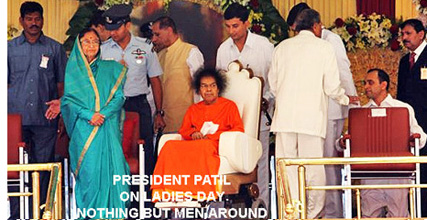
However, as to their real lives, he regarded women with much disdain and avoidance. One example, deleted by Sai censors from all available sources, but preserved by credulous devotees on websites and in books is seen above, or the following:-"Women are proverbially too individualistic! There is a popular belief, born out of folk-experience, that three women cannot live in unison! There is a Telugu limerick, which says, "The world shivers before one woman. The ocean will dry up, if there are two! And if there are three, O, the stars will drop down at noon!" Why is woman so characterized? Woman is extremely deficient in Sahana, I mean ability to bear defeat, fortitude, forbearance, patience and quiet, suffering with no thought of retaliation. That is why woman is said to be the weaker sex." (Source: Thought for the Day, a collection of Swami's Quotations published from Prashanthi Nilayam - see http://www.saidarshan.org/cgi-bin/gems.cgi?50x6)
A male chauvinist who proclaimed himself the creator of the world and of man and women, Sathya Sai Baba, decided in the mid 1990s to try to engage women by introducing a ‘Ladies Day’ on every November 19th. This came after at least five decades of his full marginalisation of women in his ashrams and organisations… made to sit at the rear of every event and not on chairs (as men he wished to flatter were). Thereafter, there was the one day a year – Ladies Day – when women did not have to sit on the ground and got prominent places! Otherwise nothing changed! Living in a male chauvinist environment, he wanted to prolong the traditional roles assigned to but a tiny handful of all females in India. Everyone who saw anything of Sai Baba’s ashrams know that it was a man’s world above all else and women took second place, if that, at best in all things that mattered except service to men in general.
In 1995 Sathya Sai Baba instituted a 'Ladies' Day' at his ashram on November 19th. On that date in 2011, the first woman President of India, Shrimata Prathiba Devisingh Patil, attended and addressed the audience at Prashanthi Nilayam. She is worshipful of Sai Baba and it was wholly evident from this address - along with many of Sathya Sai Baba's statements about women and their role in life and society - that the values she and he support are very largely opposed to those of International Women's Day, the 8th of March (see Wikipedia).
Patil said: "Today, we are gathered at Puttaparthy to begin the 85th Birthday celebrations of Sri Sathya Sai Baba.I pay my regards and I wish him the very best on this occasion. His progressive views on the role of women are inspiring." (see http://www.ssso.net/091110/191110.html)
Progressive views? That a female President of India finds Sai Baba's views so acceptable speaks volumes about her lack of understanding of real female emancipation. Neither she not Sai Baba nor
President Patil express anything supportive of the most central modern feminist ideals - equality of women with men throughout society, not least in the workplace as regards equal opportunities, rights and - not least - equal payment for equal work. What may to some seem progressive on this matter in India is seen in most modern societies are backward-looking and unacceptable. Sai Baba regards the woman first and foremost to be a home maker, a mother and a chaste second-string to her husband. ("Today is 19th November (1999). It is celebrated as Ladies' Day to remind you of the importance of the mother." (Sai Baba, Sanathana Sarathi, 12/99. p. 365). It was he who should have been reminded, since he let his own mother live in isolation (her husband having left her) and in penury (see full account and photo of the tiny shack in which she lived while he rolled in luxury in his ashram nearby).
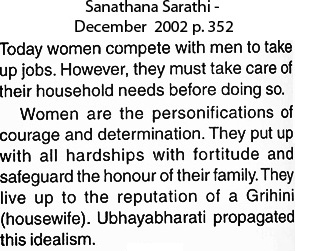
Sai Baba did not allow women on his Sathya Sai Central Trust, nor can more than a very few ever be seen in leadership positions in his organization, especially in India. He avoids women on most occasions, a frequently observed and reported fact even by some keen devotees. Women in the ashrams who work (not the moneyed women visitors with jewels and costly silk saris) are employed mostly only in traditional women's jobs in India - washerwomen, sweepers, orderlies, nurses. A few are doctors at his hospitals. Women are in general not provided with the same facilities as men at ashram events, such as chairs at conferences, nor are they allotted places on his much-envied veranda. At darshan Sai Baba often simply walks past the women's side and lavishes his attention on men and boys. All
in all, Sai Baba must all be very confusing to women devotees! Not least, at Sai events in the ashrams they have to sit at the back and on the ground, while men are always to the fore. But there is one day of the year - Ladies Day - introduced in the 1990s, when women get a more prominent place! Numerous students have reported that he is a strong misogynist.
In a turnaround from his “women’s place is in the home” talk, he suddenly
pronounced:
“Women too are doing all jobs equal to men. In fact,
women do work more sincerely with dedication. Svami questioned the Director
of the Indian Telephone Industries when he came to see Svami, about the
percentage of women employed in the industry. He said 99% of the employees
were women and added that women do better work than men. They do not stop
or step out till the allotted work is completed. They have the work culture
better than men. It is nowhere stated in any sacred text that women should
only cook and not do work like men.” (Sai Echoes from Kodai
Hills, 1998, p. 48-9).
Hilary Clinton expressed very clearly what women today strive for, namely the right to decide for themselves what they wish to be, aim for and to choose the lives they aspire to - which of course requires a 'level playing field'. Such a conception is entirely foreign to Sathya Sai Baba, who sees such things as expressions of ego, selfish desires and the like!

"As today is a sacred day dedicated to women, they should change themselves and help to change the men and the children. They should develop the qualities of sympathy, compassion; love and sacrifice. Study the lives of our great women, who were models of patience, fortitude, compassion and sacrifice. I desire that you should take up the reins of leadership and bring peace and prosperity to the nation by leading ideal lives." (Sathya Sai Speaks Vol 28, Chapter 32 'When Women Are Honoured')
But the patience, fortitude, compassion, and sacrifice of women are surely also - even primarily- the very qualities which have made women endure without revolt the vast injustices of patriarchal and male chauvinist societies throughout history without challenging them properly?
Here, Sai Baba sees it as exemplary that cheap women’s labour is exploited in the most boring and repetitive work of telephone exchanges. These women must work long hours, then be home makers supreme etc. etc. This is much closer to the exploitation of women than respecting and honouring them.
But Sai Baba bemoans this situation where women are empowered to work outside the home and earn. Again, he harps back to the past he wants to see us all return to: “Rama told Bharata that he should not permit women to take part in affairs of state. Women have their estimable role in household affairs, but they should be kept out of state politics. “Don`t employ women as ministers. The reason is: a nation’s honour is based upon its women. It is only when women maintain their respect and honour that the nation will be respected. It is not proper for women to cheapen themselves by roaming in public places.” …and… “How does the situation in the country today compare with Rama’s conception of an ideal government? The state of things today is 100% contrary to the ideas and ideals of Rama. How, then, can Rama Rajya be established here? If we desire to establish Rama Rajya there should be harmony in thought, word and deed… “ etc. . (Sanathana Sarathi, May 1995, p. 118). So now we see that Rama was seriously wrong, after all.
Rama's rule is Sai Baba's ideal!
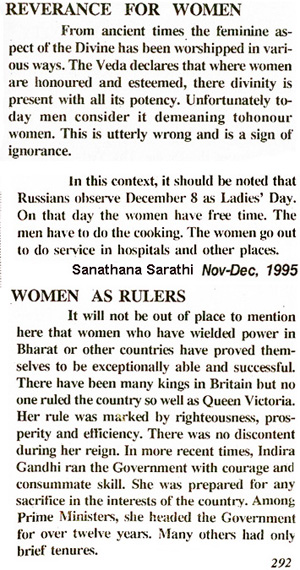
In his address on the first Ladies' Day, Sai Baba said: “It will not be out of place to mention here that
women who have wielded power in Bharat or other countries have proved
themselves to be exceptionally able and successful. There have been many
kings of Britain but no one ruled the country so well as Queen Victoria.
Her rule was marked by righteousness, prosperity and efficiency. There
was no discontent during her reign. In more recent times, Indira Gandhi
ran the Government with courage and consummate skill. She was prepared
for any sacrifice in the interests of her country.” (see Sanathana
Sarathi, Nov.-Dec.1995, p. 293)
Sathya Sai Baba’s view of British history is that of some outdated and revisionist old time Anglo-Indian, one wonders where he picked it up… a quaint anachronism that historians can chuckle over. Queen Victoria withdrew from all normal duties as a sovereign for decades, mourning her dead Prince Albert and causing huge constitutional problems due to her disinterest, wallowing in grief and comfortable seclusion. So there was no discontent during her reign? Not under the horrendous conditions in the British lower classes during the Industrial Revolution? Not anywhere in the British Empire? This Sai Baba is an original historian indeed, a marvellous joker no doubt… who really knows that it was not so, but doesn’t want to think or speak ill of anything? Congratulations! But Queen Victoria’s rule also saw the extremely brutal quelling of the Indian Mutiny or Revolution, did it not? The prosperity and efficiency was for the upper classes only (headed by Queen Victoria) and for the exploitation of colonies. So much for Sai Baba as a historian of Britain.
Though Sai Baba tries his utmost to praise women, it is mostly for their retiring and loving motherly qualities - preferable very religious and extremely too! He never recommends that they could share the values and achievements which are reserved by him for the male. Some further quotes of Sai Baba help to show the entirely out-of-date and secondary role to which women are to be relegated:-
Sai Baba seems to dither back and forth between the tradition he knows
from Indian village life and the more modern approach many of his middle-class
Indian ladies now hold. Women must in effect do two jobs if need be:- “A lady must look after the home first and then work outside, if necessary…
she can study to get degrees, enter politics or do any other work but
she should not neglect the home, which is the very foundation of her life.” (Sanathana Sarathi, Dec. 1997, p. 327-8).
"You should conduct yourself according to the wishes of your mother. Do not disobey her." (Sai Baba - Sanathana Sarathi 12/99, p. 365). This is extremely out-of-touch with reality and it is unclear to whom it is supposed to apply: though it would seem he also means adult children, who traditionally have to touch (worship<) the feet of their parents?
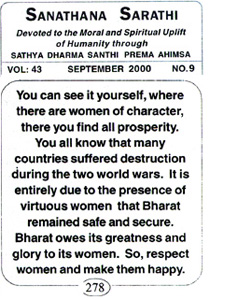
Sathya Sai Baba makes some extraordinary claims (quote on left). Bharat (i.e. India) was safe from two world wars simply because of its virtuous women? Firstly, not all India’s women were virtuous, it would seem, since prostitution was very widespread during both world wars and has increased continually since then. Now there is a massive AIDS crisis which also involves women, of course. Secondly, the greatness of Bharat… there is a suggestion here of India’s former supposed glories. India’s greatness today – whatever it consists in – does not exceed that of other countries surely? It’s glory is harder to discover nowadays, even with all due respects. One can applaud the sentiment to respect women and make them happy… but Sathya Sai Baba is known for preferring men to women on all occasions… he spends far more time on the male side during darshan and is always surrounded only by male attendants. In his ashrams – at conferences and festivals – women are relegated to sit on the ground, while important men occupy chairs. After many decades, Sai Baba agreed to have a “Ladies day” once a year. (the remaining 364 days are actually Men’s days).
Sai Baba changes tack according to the occasion or his whims:- “…in the modern world, it is necessary for the women to share the burden
of maintaining the family with their husbands and so the women should
also pursue studies as much as possible and take up suitable jobs to share
the burden of the family. It will smack of selfishness if the males prevent
them from going to work for which they have acquired the requisite qualifications.
Women can control the whole world for themselves by virtue of their inherent
qualities of love and spirit of sacrifice.” Sai Baba in a discourse,
19/4/1999 at Kodaikanal. (Sanathana Sarathi, July 1998, p. 172)
He has also stated as follows, which just shows his ultra-traditional Hindu male chauvinism, and also confusion in praising two women rulers:
- 
From Brian Steel's web page 2. Ladies' Day Discourse, 19-11-01
Please pay special critical attention to this example. This is NOT just a funny bedtime story. All is not as it SEEMS!
This recent example has been brought to my notice by a fellow researcher. The following italicised piece of an official EDITED version of Sai Baba's 'Ladies' Day discourse on 19 November 2001 contains additional padding which appears to be utter NONSENSE! The extract from the official versions is so astonishing that it raises even more questions:
1. Why did the SB Organisation, which, as we have seen, amends much of what SB says without any qualms, allow this extraordinarily damaging evidence of totally muddled thinking to appear (in slightly different versions) in print (Sanathana Sarathi, January 2002, and on the Internet, www.eaisai.com/baba ?
2. What were Baba's original words? Could they have been even more nonsensical? How can we tell? The recently announced 'Premsai' Internet version was originally not available when I searched on several occasions ("Page not available") but it has appeared in the last few days.
(A propos of Premsai and its valuable literal versions of recent Discourses, my fear is that perhaps with the unwelcome publicity, the whole site may be closed down, by order from above. So, please copy as many of the Premsai discourses now available - in several languages - for later study and comparison with the official versions! http://www.internety.com/premsai)
This is the short passage from the Ladies' Day Discourse (first in the www.eaisai.com/baba version).
"So be happy in the present. Swami expects all parents to achieve fulfilment in their lives by moulding their children into virtuous persons. They should always aspire for the goodness and well-being of their children. It is a good boy who becomes a god boy.
"How did the term good boy get modified? During the British regime, they used to say good boy. Later it became good-bye. Thereafter, the word 'good' vanished and 'bye' has remained. In this way, with the passage of time, various words have become perverted. But what we should accomplish is being a good boy. Give up selfishness and become selfless. Self is lovelessness and love is selflessness." [Italics added.]
For comparison, here is the very slightly different version printed in Sanathana Sarathi, for January 2002 (p. 22).
"It is a good boy who becomes a god boy. A bad boy can never become a god boy. How did the term good boy get modified? During British times, they used to say good boy. Later it became goodbye. Thereafter the word 'good' disappeared and 'bye' has remained. In this way, with the passage of time, changes occur in words and their meanings. But what you should accomplish is to become a good boy. From good boy you will gradually become a god boy."
So, any reader will immediately see what is wrong here and point an accusing finger: nonsensical!
1) Print this Page 2) Use right click here - then 'Open page in new window' to translate
Select the text to translate, copy and paste it into the box (see above) and select language required.