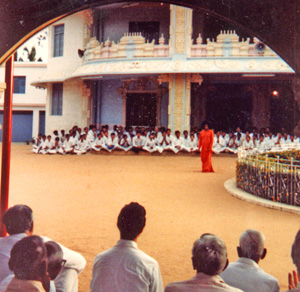
Darshan at Prashanthi Nilayam in January 1985
photo by Robert Priddy
Darshan at Prashanthi Nilayam in January 1985
photo by Robert Priddy
On my very first visit
to PN (1984/5), I was in the mandir for bhajan a number of times. There
was a tremendous lot of waiting for things to begin, and - now and again
- Sathya Sai Baba would be glimpsed through the doors or the small windows going
past us on the porch. One evening I was sitting in the temple, which
was packed with students and devotees awaiting the start of evening
bhajan. Being long in the torso, I could see through one of the small
narrow windows onto the veranda, where Sathya Sai Baba stood talking for 15 or more
minutes to the deputy head of the ashram at the time, Mr. Chiranjia
Rao. No one around me as able to see this, as the angle of view was
such that I alone could see them, so I thought myself very fortunate
to see 'The Avatar' at such close quarters.
Chiranjia Rao stood with hands in the prayer attitude (namaskaar) and discussed
with Sathya Sai Baba , who had a serious and mostly quite gruff and displeased look. I was surprised
at the apparent unfriendliness of the expressions of both Sathya Sai Baba and Rao.
They had what appeared to be a rather heated, back-and-forth discussion
in Telugu that lasted for all of ten minutes... though it seemed like
half and hour to me. Sathya Sai Baba did NOT look at all pleased, and did not smile
once. Though Rao held his hands in the obligatory namaskaar, he seemed
rather forceful in his replies to Sathya Sai Baba . This jarred with my idea of how
relations were supposed (by all accounts) to be between Sathya Sai Baba and everyone,
including his staff. Rao seemed to be under cross-examination and getting
some telling-off at times, to judge by Sathya Sai Baba 's scowls... but Rao also
seemed undeterred. Sathya Sai Baba 's expression was never once the slightest bit
benign or friendly.
I was very puzzled... and my mind set about finding some explanation
or excuse for Sathya Sai Baba . (i.e. 'He is just testing or deluding us!' and suchlike
defensive tricks from his teachings). Eventually I gave up trying to
figure it and told myself, 'Well, you got a good darshan there all right!'
At that phase of my devoteeship,I was then uncritically accepting of
nearly all the major claims about Sathya Sai Baba and was enamoured of all the amazing
stories from books and films about Sathya Sai Baba and - though I felt it was very
peculiar to see this avatar of love apparently ticking off his servant
so testily and for so long and with such expressions, I rationalised
that I could not understand anything about it. even thought this must
surely be enacted by Sathya Sai Baba knowing that I was a witness ... etc. etc.
How gullible can one be made to be!
However, nearly 20 years later, I am still able to recall much about
that long 'darshan' (as these views of Sathya Sai Baba are called) and at last it
makes sense... Sathya Sai Baba is a hard and unforgiving taskmaster who has to struggle
to keep the various corrupt and mostly only half-believing officials
in line. He is not "all Love and nothing but pure love etc.",
but he is mostly just as I saw him then. Unfortunately all my misguided
noble thoughts clouded my intuitive vision...
Now I am able to look on that exchange in quite another light. It seems that I was, so to speak, seeing behind the more usual maya veil of greetings and smiles - while unable to realise that I was seeing the ordinary aspect of Sathya Sai Baba , the day to day bossy ruler dealing with a stubborn or perhaps rather dull-minded lackey (a former railway clerk) who was reporting back. Had my mind not been full of the miraculous mysteries and burning enthusiasm to see the world changed through the avatar etc. etc., I would have recognised the revealing ordinariness of this straight away.
When I visited Prashanthi Nilayam nearly two years later, I got to know an Anglo-Indian called Alfred Brinnand, who speaks Hindi. He told me that Chiranjia Rao was ever snooping about the ashram precincts to see whether visitors were getting too friendly with residents. I have long suspected that Sathya Sai Baba gathers information about visitors through his minions.
Alfred Brinnand knew - and introduced me to - a Chinese man from Singapore who was a resident in Prashanthi Nilayam, a man with a very serious degree of disability due to some unusual condition. This man understood Telugu too and told Alfred about a murder that had just taken place right in front of the accommodation office in broad daylight. The circumstances were most peculiar. The gate-keeper Kumar, who had been a bandit and whom Sathya Sai Baba had surprised and called to come and serve him, was a brutal man known for beating Indian peasant visitors and even some European visitors. He had reportedly raised the ire of a priest in a Shiva temple who had visited the ashram now and again. The Shiva priest came up to Kumar while he sat on a bench in front of the offices and asked his forgiveness and to touch his feet. However, when he held Kumar's feet he bit off his big toe on one foot. I was told that these priests, who haunt burning ghats and the like, often sharpen their teeth for biting heads of chickens in sacrifices. The shock this caused was so great - doubtless combined with superstitious fears - that Kumar died from it in the ashram hospital within a couple of days. Where but in India can one hear such things, or do such things doubtless occur? It was this event, however, that Chiranjia Rao and the ashram staff were trying to stop coming out and they were extra vigilantly watching residents who knew about it and what contact they had with foreigners, according to our informant. Alfred had seen both Rao's (Head of ashram Kutumba Rao and his deputy, Chiranjia Rao) on the veranda in apparent abject anxiety at Baba's wrathful looks after it was discovered that the gatekeeper's room had turned out to have tens of thousands of rupees in small denominations hidden behind the picture of Sathya Sai Baba ! He had been taking bribes from poor people to enter the ashram. Such things were supposed to fall within their area of responsibility... even while the 'omniscient' Sathya Sai Baba - is repeatedly said by various writers to 'look after every detail' in his ashram himself!
Apropos the preceding, a Russian colleague wrote the following to me: "A memory has come to my mind and it may be useful. It was I think in 1996. When we came to PN we were surprised that there was a sort of public relations office and there we saw a westerner. This person was about 35, rather tall and strong complexion (it seems to me he was from Holland). We were explained that he was in charge to contact with western devotees coming to PN and to deliver an orientation lecture and so on. And we did have an orientation lecture about how to behave and how to be careful because "moths come for light and frogs come for moths" etc. Anyway, it was nicer than when it was done by an Indian guy. But this PR did not exist for long. Later, when I left PN or maybe even next year he left the ashram forever. Some people said that Sathya Sai Baba gave him the sack. I was told by a person whom I cannot doubt that he wrote a letter of explanation and his mother distributed this letter in PN. In the letter it was said that Sathya Sai Baba offered him to spy in the ashram and when he refused, Sathya Sai Baba said that he might leave. And he left. Many Russians considered it as an acute test from Sathya Sai Baba . Some believed he had failed but others believed he had passed."
As soon as the distorting rosy glasses are removed, more and more aspects of the hidden Sathya Sai Baba and his activities emerge clearly into consciousness. Those who think they are blessed in wearing such glasses seem to fear removing them for an instant in case they have to lose their (false) sense of security and realise what dupes they have been. That is tough... but the truth never was very easy.
Though some experiences are shared (like the physical manifestation of vibuthi etc.), the meaning one gives them is personal and private. Basically, all experiences are subjective in that they are selectively perceived and interpreted. One comes to Sathya Sai with one's head filled with stories and testimonies of people which one has reckoned are accurate and reliable, and one's heart is ready to accept almost anything. Their and one's own experiences are still only 'appearances of objective reality'… for reality is vastly multi-perspectived so that what appears so from some angles is often shown to be quite otherwise from others.
The simplest kind of example of difference between appearance and reality is the famous stick that appears bent when in water, but is 'in reality' not so. But the most complicated examples of the gap between what appears to be true and what is true are those practiced on us by our own kind. Both deceptions of many kinds have even taken centuries to penetrate and expose, those which rely on half-truths being among the most impenetrable. Common and well-tried knowledge may not be adequate to explain what one experiences, but if it is rejected in favour of explanations which cannot be tested in any way, then delusions easily begin to take over.
The number of books about experiences with Sathya Sai Baba run into the hundreds. Many of them describe experiences of what we might just as well call 'miracles', in that they appear at the very least to break all commonly known physical laws. I have detailed accounts of some of the more remarkable reports elsewhere. Some see specific 'visions' that are - or seem to be - caused by him, while others in the same room report seeing something else or, more often, nothing at all unusual. This occurs continually without any observable preliminary signs of hypnosis or similar techniques being used. Still, there is no doubt that nearly all the followers of Sathya Sai Baba are psychologically very much predisposed to suggestion, but how this is brought about by Sathya Sai Baba is itself not fully known, nor is it open to genuine investigation. However, comparable known experiences are induced by hypnotists (such as seen on TV) , by hallucinogenic medicines or drugs and uncommon states of hallucination in high fever, extreme thirst, excessive blood loss and various suchlike physiological conditions. There are many recorded examples of persons who can 'imprint' perceptions on other persons' minds. Some examples have been well demonstrated on film by the English illusionist Derren Brown and the former illusionist Wolf Messing, though much written about him is far from being verified, was able somehow to 'imprint' through an apparent telpathic ability.
Facts
about the actions of people cannot, of course, be tested by reference
only or mainly to one's accumulated 'own experiences'. We very often believe
our own experiences too hastily and naively, the reason being that they
are conditioned in very many ways by our previous experiences, what we
have chosen to believe in general, what we are looking for, what we do
not want to pay attention to or know too much about. The die of experience
is slowly built out from the cradle onwards, where perceptions are still
extremely subjective and incomplete. Experience becomes less subjective,
narrow, limited and (hopefully) less distorted as one matures. But subjectivity
is always the basis and in many people the process of liberation from
habitual thought patterns and second-hand knowledge (which constituted
at least 90% of what we accept) slows down and stops. Some are so oppressed
by this that they 'run into a wall' and may suddenly convert to a new
faith which they hope promises a release from their predicament. We often
exchange some people's knowledge and ignorance for someone else's different
knowledge and ignorance. Nothing is learned by naval-gazing independently
of contact and continued interaction with the actual world. In other words,
most perceptions we have are heavily pre-conditioned, as are the ways
we make sense of them (i.e interpret our experiences). Then, no amount
of reliance on one's experience and (often faulty and selective) memory
to date can reveal how facts not yet perceived or investigated may or
may not be. Should you not already be predisposed to believe some thing,
you will probably not easily be able to discover whether it has any real
basis.
Perceptions of what is 'not really there' occur all the time, far more often than is realised. This is because we interpret our 'sense data', both at a subconsciously-habitual and at a conscious mental level, according to many different kinds of influences on our minds. When experiences are of the sort beyond the normal run, the person's whole frame of reference, reason and vocabulary can be sorely tested. Confusion, misinterpretation and their often very serious effects then become the order of the day. For example, one comes to believe that one knows Sathya Sai Baba is what he says he is, while it remains a belief, whatever one may say... belief based on subjective interpretations of one's experiences and other people's subjective accounts. One cannot know, for example, that Sathya Sai Baba 'knows everything' unless one can check from knowing everything oneself. One may be convinced, but one can also often later find one was mistaken.
The more subjective interpretations arise in all kinds of 'numinous' experiences, where uncommon perceptions or so-called 'paranormal' events, normally inexplicable events, and so-called coincidences or 'synchronicities' occur. Such may be triggered by many physical and psychological conditions. These range from fever hallucination, extreme physical states (sleep deprivation, hunger, major blood loss) to the effects of chemical agents (so-called 'drugs'), or by affecting a person's perceptions through trances, self-flagellation, tantric yoga and other spiritual practices. This also includes intervention in a person's energy system by a person of abnormal powers, whether from yogic shaktipat (transfer of perceptions by touching of the chest) or various kinds of ritual (eg. such as go under the title 'black magic').
The accumulation of projections and mental derangement. The degree to which either the environment or the mind-set of the person is the more influential will vary very greatly. The tendency to 'project' all kinds of internal states, beliefs, prejudgements etc . onto external events and persons has been experienced by everyone. It is a most powerful psychological function, if not halted leading one further and further - and usually gradually and step wise - towards considerable derangement of the reason and even of one's on-going perceptions. However, the mindset not only is involved in partly 'producing' what one experiences, but also in interpreting it all... and can therefore just as well distort everything systematically. Perceptual projection and interpretation can turn neutral or negative facts into positive ones, as well as vice-versa. The 'rose-coloured glasses' approach can be over-positive... and so just as misleading and potentially dangerous for a seeker as an over-negative approach. But to achieve a clear view, without any distorting glasses is the ideal...
A too negative attitude can produce anxiety, even loathing, repulsion, fear and terror, especially when backed up by a traumatic past, or a nervous or unbalanced disposition. Psychiatric hospitals have innumerable patients who have had visions and heard voices (psychiatrically termed visual and auditory hallucinations), which are often experienced as extremely negative and life-disrupting.
Whether such changes in 'normal' perception are felt to be positive/heavenly or negative/hellish depends to a great extent upon the psyche of the person affected. A concentrated positive mindset is often followed by satisfactory experiences, especially when deeply ingrained over time and backed up by supportive social and emotional attachments. This occurs very often, for example, at much longed-for and often long-awaited darshans and interviews with Sathya Sai Baba.
How far the positive or negative aspects predominate depends also, of course, on the environment (persons present, plus many and variable other environmental conditions according to the person's habits, expectations and tolerance levels and also relates to their entire mental and emotional make-up since childhood).
A relatively very objective and neutral observer will differ from a person who is largely wrapped up in their subjective cocoon of beliefs and desires. The more involved and many-sided this kind of belief/cum/projection grows, the harder it is to penetrate, either from outside or from within! There are, of course, persons who suffer from psychotic and schizophrenic distortions of reality and many who are close to this who are still able to function to some extent in normal society. Victims of mind cults, such as the Sathya Sai Baba movement is, are in a similar position. It seems to be a fact that an unusually high proportion of them also suffer from developing mental illness.
The accurate reconstruction in memory of radically mind-altering experience after the fact, however long or brief, is extremely difficult and is not easily undertaken by many without special skills. Understanding and interpretation of what actually happened, at what level and exactly how, as well as what it meant at the time and can mean for the future, vary enormously with the person involved. It depends on the nature of their experiences, their basic beliefs and attitudes, the qualities and the structure of their psyches, as well as learned skills like reasoning, knowledge, and expressing feelings and thoughts.
Belief divine, doubt demonic? The committed follower has always been taught and has accepted that doubts (but only about what one is supposed to accept) are negative, unproductive, bad and even of a 'demonic' quality, and this is inevitably taken to mean doubt of Sathya Sai Baba in any respect, though Sathya Sai Baba himself has only seldom denounced those who doubt him. However, self-doubt is encouraged to an extreme degree by Sathya Sai Baba in his constant sweeping criticism of all devotees' behaviour and his strong demand for self-examination according to the strictest fundamentalist religious norms. Much of his teaching calls for self-denial, removal of all natural desires and represents a strong form of potentially destructive self-denigration. This diverts one's doubting capacities towards oneself and away from Sathya Sai Baba and his fraudulent practices, ignorance of science and religions like Christianity etc.
The human mind is also prone
to making comparisons, reasoning, cross-checking and thinking along many
lines of explanation… so doubts of one kind and another inevitably arise.
The whole of scientific discovery since the Renaissance is based on systematic,
constructive doubting of traditional supersitions and wrong theories. Many `imaginary doubts`
also occur and - due to their nature, may be either overcome, or ignored
and forgotten or they eventually dissipate. Yet when such doubts are stimulated
by observable events or indubitable facts that come to light suggesting
that Sathya Sai Baba is mistaken about facts, or in claims or prediction he makes
or that he shows signs of being neither omniscient nor omnipotent, the
average follower takes recourse to avenues of escape, such as:-
1) Wait and see, give the benefit of the doubt, make no hasty judgments,
look on the positive side, ignore bad things, ask whether it affects you
personally and is `your business` etc.
2) Set about rationalising the doubts through interpreting the teachings
- or some suitable part of them - to dispel the doubt.
3) Resign oneself to the inevitable, to ignorant humility, to general
confusion and denial. Seeing
the production of holy ash by a wave of the hand daily, and especially
getting an interview where great charm is combined by Sathya Sai Baba with remarkable
clairvoyance and what many observers consider to be genuine manifestations
and apports of objects and eatables, despite many now-known instances
of sleight-of-hand now known and his proven fraud in claiming that the
baubles he gives away to be unique and to contain genuine diamonds etc.
(One actually has to look for sleight of hand consciously and carefully
time and again).Throughout
the world, many persons gain a hold over people through charismatic charm,
a record of helpful unselfish activities, psychic powers, and by the repetition
of religious and spiritual teachings little known to them previously.
Even without convincing 'mystic powers', many worldly leaders like Hitler,
Stalin and Mao won their positions by charisma plus good works for their
nations... at the outset.
Serious literature about spiritual gurus is full of accounts of such 'masters' from almost every conceivable angle, not least their usual deceptions and - all too often - their sexual deviances. When such a person has managed to convince enough people that he constantly knows everything everyone thinks or feels, they are invariably willing also to believe he must be a holy saint at least, even a deity. Add to the above a simply stated teaching with some common sense laced with positive values and elements of deep insights from the fund of spiritual teaching, and faith is bolstered, even though it also relies on many half-truths and outright deceits. That is what Sathya Sai Baba has done.
"...the obvious fact of the matter:
many of Sai Baba's miracles are carefully calculated in terms of their
timing and psychology and, therefore, aim to stun the potential disciple
to put him or her off balance and, in that way, win over his or her doubt
and resistance. They are part of the aforementioned puzzling games and
the building of a personal relationship in which Sai Baba holds all the
strings in his hand. It is important to see through Sai Baba's purpose
in making people defenseless through his demonstrations of power." (from "Guru, Miracle Worker, Religious Founder: Sathya Sai Baba" by Dr.
Reinhart Hummel)