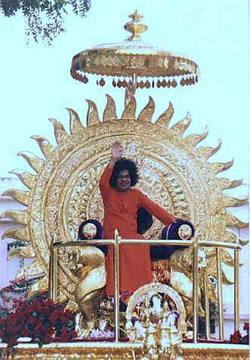
One cultural difference between many devotees from the East and the West is the attitude towards show and extravagance. It originally appealed greatly to spiritual Westerners that Sai Baba's life was an example in living without material luxuries and in an eco-friendly, non-consumerist way. His doctrine was very markedly against waste of money, time, energy and food (his ‘Ceiling on Desires’ recommendation). His giving away of necessities to the poor and distribution of food etc. are practical aspects of this philosophy.It is understandable that ashram facilities for visitors have been much improved since the 1980s, considering the enormous amounts of money donors have also given for this purpose. (The price for the right to use a one-room flat with minimal furnishing for up to one month per annum (and no longer!) had reached $US 7,000.- by 2000, plus daily rental costs while in occupancy!
Through the years I have learned that an appreciable number of Sai followers from Europe and the US feel that increasingly large-scale time-, energy- and money-consuming aspects of the showpiece festivities put on by the powers-that-be in these matters, such as for some of the birthday celebrations and major festivals, could well be considerably reduced. Why promulgate a program of ‘Ceiling on Desires’ while wasting time, energy, money and food on constant festival binges? Much material and effort goes into lengthy preparations and extensive light and flower decorations for the constant round of festivals major and minor which are popular mainly with the wider Indian public. (That these are especially welcome as holiday breaks of monotony for the very poor peasantry of the whole region, who swell the numbers greatly and also may receive free food and some even gifts of clothes etc. is certainly at least no argument against them).
Many Indians and other Easterners – who make up the overwhelming majority of visitors to SB’s ashrams - evidently want their god-guru constantly to be surrounded by outward signs of his greatness and make great financial efforts to affect this. He condones many such efforts, according to his own explanations, solely because of the devotion and goodness of those who make them. Yet this going along with such extravagance has only encouraged more and bigger showpieces, which he also invariably accepts and certainly also seems to revel in himself. For example, silver motorised chariots, golden thrones, huge light displays, pomp-filled birthday and many other celebrations. In discourses, SB has also criticised expensive aspects of ceremonies as the ostentatious Golden Chariot at the Paduka celebrations and asked for it to be sold and the money used for service instead, but he continued to mount it yearly even after this disavowal. Other wasteful projects include the expenses of laying a cricket field and other arrangements for an international cricket match in 1997 with its 20kgs. solid gold Cricket Unity Cup and solid silver trophies, excessive Las Vegas type illuminations and other showpieces at SB birthdays and many more festivals.
That teacher preaching ‘Serve All, Love All’ should use such huge funds for such publicity in Andhra Pradesh, where many live on the poverty line and clean drinking water still is extremely scarce in huge areas, is beyond serious explanation. The tasks of correction and maintenance of the incomplete and often malfunctioning super-costly ‘Water Project’ that SB caused to be installed with improper planning and undue haste (to be complete for inauguration on his own 70th birthday!), were soon shed onto the AP State authorities. Facts about the malfunctioning are known to Indian experts in water management and not least to the Central Trust, but it is not admitted and all such problems are suppressed on their publicity website.
All in all, some of the paperwork directives from the Overseas Chairman and others calling for financial support for such projects have confronted many of us with the fact that the SSO has slid gradually further and further away from SB's teachings, especially from his insistence on the importance of quality of spiritual work and an organisation based on inner motivation, rather than one supposedly ‘run by leaders’ to achieve worldly projects.
More details of wasteful buildings & other projects blessed by Sathya Sai Baba
Far from all members are able to reconcile this with Baba's teachings about correct use of money and the primacy of care to the poor, , the very costly "Eternal Spiritual Heritage Museum" and a huge architectural hodge-podge celebrating the Sai universal mission, "Chaitanya Jyothi" reportedly costing over US$5 million, was added in 2000. Numerous recent buildings have been pulled down, such as the Sai Ramesh hall at the Whitefield ashram - a costly pandal hall which was superceded by a much more 'pukka' structure after only a few years use.
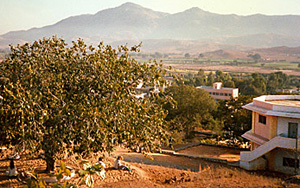
Then there was the Sri Kasturi Reading Room - pulled down after a few years to make room for including the huge and ostentatious luxury apartment building for statesmen VIPs that is seldom in use. All this bad (non-prescient?) planning is also seen in the demolition of the one-time Shanthi Vedika at P.N. which became a hindrance, the permanently unoccupied luxury apartment villa built beside the Western Canteen and Roundhouses for a Princess (of Thailand?) A former ashram shopping centre at Prashanthi was later replaced recently by a much larger one. A very luxurious 'lingam-shaped' temple at Muddenahalli, between Puttaparthi and Bangalore, managed by the Sathya Sai Central Trust, cost over Rs. 200 million when built around 1993 on the lines of the Prashanthi Nilayam mandir, with a luxury apartment complex for SB and his entourage. He visits the adjoining school complex, but has not (yet) even stayed one night in the empty apartment. At the Hillview Stadium a costly cricket field project was completed, but only one match took place, where a 20 kilo gold cup was presented to the winning team (see below)!
So we now have, for lower middle class Indians and peasants, a minor Tirupati, or a minor Shirdi. That is the way India still works. Pop religion is thriving there, especially under more modern gurus like Baba Ramdev – who makes no divine claims, except perhaps about the curative powers of Yoga. Until education levels rise for the “plebs”, it will remain so.
1) Eternal Heritage Spiritual Museum:
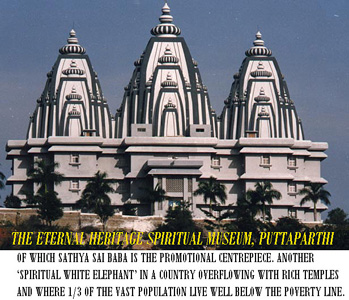
This extremely expensive and rather superfluous and misleading 'museum' is no museum in any known sense of the word, and most of its artefacts are brand new ones! Many were solicited by the Sathya Sai Organisation, which required a contribution from each country. Sathya Sai Baba's advent and teachings are the centrepiece of the Museum (somewhat peculiar in that he is not even dead yet), and it is all presented with pomp, tinsel and expense. In short, all SSB has often deplored verbally, but which evidently impresses most Indians. Though the general intention of the heritage museum to illustrate what is universal in religion is good, the results are flawed. For example, when the museum was being installed, V.K. Narasimhan was visited by a foreign lady called Parvati (a middle-aged long-term ashram resident), who had been delegated the job of setting up the section on the Jewish faith. Not being a Jew herself and knowing very little about Judaism, she wanted N's information and advice.The Eternal Heritage Museum exhibit subsequently represented the Bible's Ten Commandments as eleven such, starting as follows: "No 1: I am the Lord, Thy God, who brought thee out of the land of Egypt, from the house of bondage." After that comes No. 2: "Thou shalt have no other Gods before me.... etc." No. 3: "Show mercy unto thousands of them that love Me and keep my commandments." The huge costs of the building included three human lives: three US devotes were killed in an avoidable accident when the concrete dome collapsed and crashed through three floors, crushing two ladies to death and 26-year old Michael Oliver, who lived 11 hours in great pain with nine fractures and internal injuries. The matter was hushed up immediately. That the parents of a daughter killed have received no proper explanation, not even an offer of compensation, is thought by some to augur ill for the inauguration of such a 'Spiritual' Museum.
2) The Kulwant Mantap
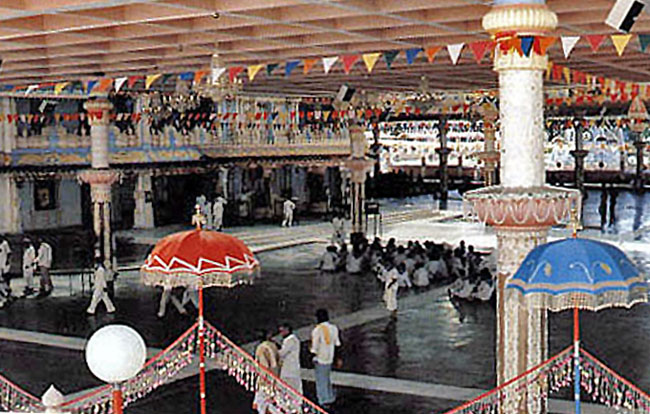
The multi-million dollar development of the lavish marbled temple area with a pukka roofing supported by dozens of elaborate tall pillars with a huge moveable glass roofing section (very seldom opened) and a completely unnecessary 150-plus huge chandeliers. Successive extensions have been made to increase its size to about 10,000 capacity when packed tight. It was donated by one of India's richest magnates, who has been investigated for corruption.
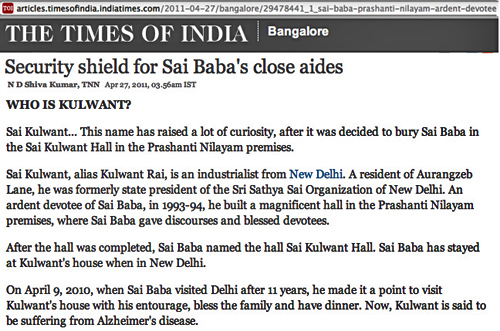
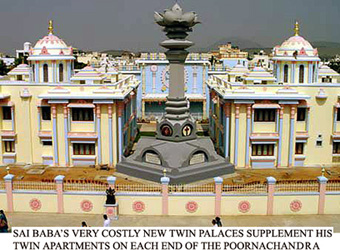
3) Yajur Mandir The new twin apartment building erected as residences for Sathya Sai's residence and his most favoured students. This is the third and largest apartment built within Prashanthi Nilayam exclusively for Sathya Sai Baba. The first set of rooms were where the infamous murders in Sai Baba's bedroom took place in 1993, whereupon two new well-fortified twin apartments were built into the existing Poornachandra auditorium. Since 2000 the new construction began to rise. These sumptuous buildings are but two among many which Sathya Sai Baba has for his sole use in other places, such as at Madras, Mumbai, Muddenahalli and elsewhere
4) The Sathya Sai Super Speciality Hospital at Puttaparthi
was originally thought by V.K. Narasimhan, a close servitor of Sai Baba and a veteran and prestigious Goenka prize-winning economic journalist, to be a huge waste of money, viewed as a serious contribution to the massive health problems of the peasant populace. The number of patients it can handle was and still is nowhere in the proximity of the number of deserving cases. The money could have been better employed as prophylactic medicine for huge numbers of the poor, such as in ensuring that all received necessary vitamins and simple medicines, rather than in performing a limited number of very high-tech. Operations. On the other hand, the signal effect of such a hospital environment in such a poor place, and the fact that it was possible to build it and run it, eventually won over Narasimhan from most of his original scepticism about it. There has, however, been some public controversy about its clinical cleanliness and claimed results. It is not open to independent health inspections by regulatory bodies.
Hospital Staff Buildings: An American friend of the author, a retired engineer, was at an interview where someone asked why the hospital accommodation had stood empty for nearly 2 years. SSB had replied, 'It was to give time for the snakes and scorpions to leave'. This may make sense when we read what he said in a discourse, "Many sit here near to me. But are they dear? There are scorpions and snakes near to me in Puttaparthi. Are they dear? No!" (Sathya Sai Speaks new ed. Vol. 25. Ch 9, p. 94). One can imagine that there were many who wished to get some kind of work in the hospital so as to claim need for accommodation, but they probably would not have waited indefinitely for this.
A strange fact remarked on by many visitors is how few people are usually seen in the two (strictly private) super-speciality hospitals (Puttaparthi and Bangalore). One would imagine that hospitals allegedly offering free medical services would be flooded with millions of applicants in this state of Andhra Pradesh, one of the poorest of the poor. The selection procedure is not made public, nor are any registry or other details of activities available.
5) The Sathya Sai International Airport, Puttaparthi
In such a desperately poor State as Andhra Pradesh, it seems most wasteful, as did the airport beside it which stood unused for years and while operative with weekly flights it was used less than ca. 5% of each week and many flights were not full either. V.K. Narasimhan was present at the interview in 1990 where airport authorities were present, led by his devotee Mr. Maharaj Krishen Kaw in his government capacity as Secretary of Civil Aviation. Sai Baba convinced the Indian Airport authorities to finance and build the large (allegedly Jumbo jet capacity) airport near Prashanthi Nilayam, telling them that they would earn 10 lakhs of rupees in the first year. But no paying passengers even flew in or out during the first year.
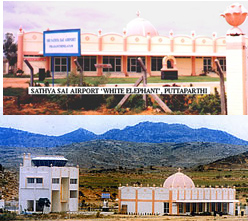
The frequency of traffic, at best, about 2-3 flights of medium jets per week for several years during the periods while Sai Baba was mainly at Prashanthi. This ensured that earnings were minimal and well below costs. Since Puttaparthi was virtually deserted during the hot months when Sai Baba was away, no visitors came at those times. It was virtually closed often in the 1990s. It is truly hard to rationalise such a huge waste of funds in such an impoverished land! The reason was Sai Baba's patently obvious desire for 'name and fame'. This airport ran at a loss since its inauguration and this seems to be the main reason which the Sathya Sai Central Trust offered it for sale in 2007 along with a sweetener of a large tract of land for property development, but no one made an offer and it remains unsold in 2014. This airport has been a white elephant, virtually in the middle of nowhere, sometimes used only by the occasional VIP in a private jet - like the Vice President of India - as a stopover on the way to elsewhere.
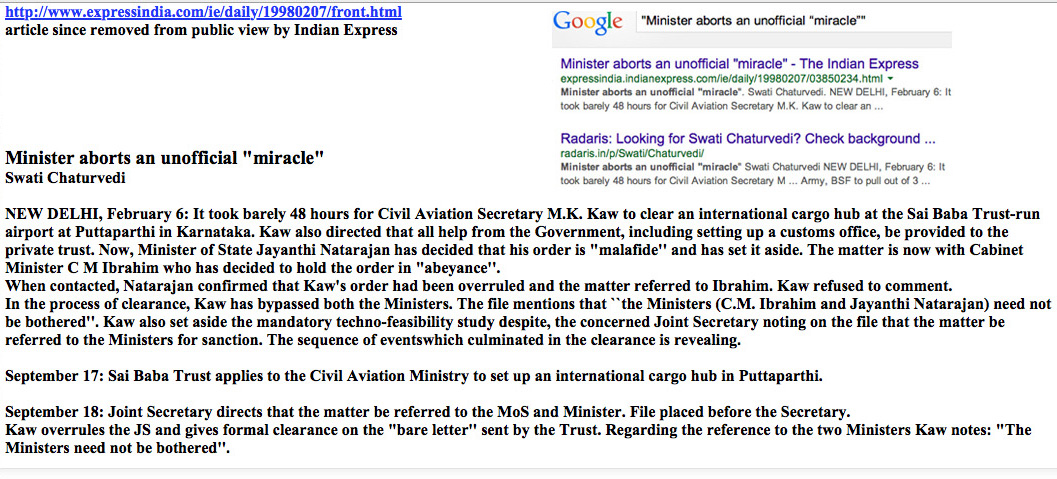
Mr. Kaw tried to trick his superiors but was caught out: The Indian Express journalist from New Delhi, Swati Chaturvedi, exposed and documented (7 Feb. 1998) the corruption of Mr. M.K. Kaw - a favourite devotee of Sathya Sai Baba acting on his behalf. As Civil Aviation Secretary, originally arranged for Indian Government permission for the Sathya Sai Airport to be built. No one knows who funded it, as the Sathya Sai Central Trust financial accounts are not open to public scrutiny, but the same Trust apparently ended up owning it. He wrote "It took barely 48 hours for M.K. Kaw to clear an international cargo hub at the Sai Baba Trust-run airport at Puttaparthi in Karnataka. Kaw also directed that all help from the Government, including setting up a customs office, be provided to the private trust. " However, the Minister of State Jayanthi Natarajan confirmed that Kaw's order had been overruled and the matter referred to [Minister C.M.] Ibrahim. Kaw refused to comment In the process of clearance, Kaw has bypassed both the Ministers. September 17: The Sathya Sai Baba Central Trust applied to the Civil Aviation Ministry to set up an international cargo hub in Puttaparthi. Indian Express Minister aborts an unofficial "miracle" (deleted at source, click here to read the original text)
6) The One-used Cricket Stadium and Golden Cup
On 30/12/1997 world cricket stars and TV stations were invited to a ‘Cricket Unity Cup’ on an expensively-prepared field in the Hillview Stadium, Prashanthi Nilayam. SSB is reported as having said: “It will be brought by four boys in a trolley. It is very heavy. It cannot be lifted. It weighs 20 kgs. Pure gold.” A college teacher exclaimed; “1 Crore, Swami!” (i.e Rs.10 millions) SSB: “Yes, yes.” Teacher: “Individual cup, Swami?” SSB: Yes, yes. Each player one Cup. 1 Kg. of silver. Round cup, one side ball, one side bat. We can keep fruits on it. It can be used in daily life. Outside they give plate on which they write. After some days it becomes copper. This is pure silver, pure gold.” Teacher: “Swami, it is written in Suka Naadi that Avatar will hoist the Sarvadharma flag; and that will be the turning point for the unity of the world.” SSB answered: “Time has come; time has come. Yes, in Suka Naadi it is there, in Sukha Naadi it is there.” (see full text of conversation of PN teacher with Sai Baba here)
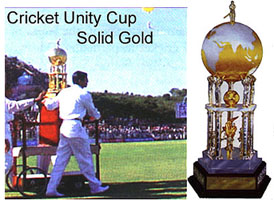
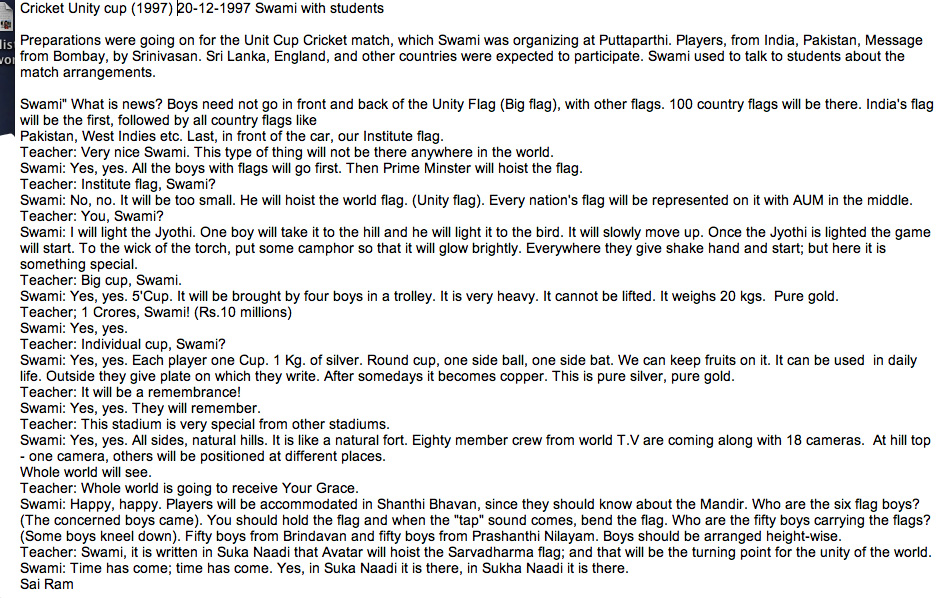
Only a few famous players came, including Sunil Gaveska, Sachin Tendulkar (both long-term devotees), G R Vishwanath, Viv Richards of West Indies and lesser-known Doug Brown (only UK player). Flags of 100 countries were carried past by students. The event was a media flop. The huge solid gold cup was given to the winning team and all players were presented with each their solid silver cup.
7) Statues at the Hillview Stadium, Puttaparthi, there are a large number of extremely tall and massive statues representing, among others, Shiva, Buddha, Moses, Christ and a monster statue of Hanuman holding a mountain aloft. These are gaudily painted and look like overblown kitch.The SSO may not have contributed financially, none can tell, but at what cost they were all erected one can but wonder. For many Western visitors these statues typify the usual Indian extravagence and waste among such enormous poverty and suffering.
8) Illuminations, chariots of silver and gold: The 70'th birthday was marked by wasteful extravagance (as are many other festival days each year designed to attract maximum local villagers crowds). Hundreds of moving tableaux/light shows made a kind of mini-Las Vegas or Blackpool, stretching the length of the main road in Puttaparthi, over one kilometre in all. These were erected, ran for some days and were then removed. There was an opulent silver chariot in which Sai Baba rode through the crowd of about 250,000 (toted by Sai Baba and his officials as being 3 million, and believed by the credulous too!). The silver motorised chariot comes in addition to the famous and most lavish 'Golden Chariot' which was used for several years for the so-called 'paduka' celebrations. There is also a full-size statue of Sai Baba in gold, presented by an italian devotee.
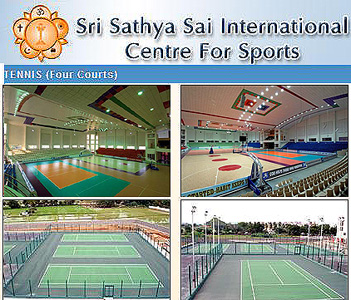
9) The Indoor Sports Stadium - built in 2006. This stadium was inaugurated by the Harlem Globetrotters demonstration basketball team.. a 'bread an circus' presentation to draw crowds instead of it being anything spiritual or 'divine' whatever. The stadium is clearly built with major commercial intentions and, though it has been virtuallty unused most of the time, it has recently been converted at very considerable expense to a tennis stadium of Olympic standard intended to be inaugurated with a championship tournament between India and the Philippines. But Sai Baba created another fiasco early in January (2008) by messing up the international tennis tournament between India and the Phillippines in the Puttaparthi Tennis stadium over a small matter of protocol (especially built to attract tourism and thereby doubtless to regenerate the failing cash flow in the coffers of the Sathya Sai Central Trust due to loss of overseas donations. Announced as being of Olympic class, along with predictions reported as made by Sai Baba that India would host the 2020 Olympics, virtually beyond imagination after the huge disaster of the Commonwealth Games in Delhi, the stadiumlooks like another white elephant,(see comment here).
10) The 2001 'Chaitanya Jyothi' museum - major showpiece: Indulal Shah proposed yet another large building project (tentatively named ‘Sai Darshan’) for the 75th birthday of SSB, to be presented by overseas devotees. The decision to forward this proposal was evidently taken by him, but assigned to Overseas Organisation. It was circulated in a (typically undated) letter from him to all overseas Central Coordinators. It was a “commemorative building project assigned to Overseas Organisation and the International UNESCO Conference at Prashanthi Nilayam” as planned for Nov. 23rd 2000 (75th birthday). It was to be an “unique monument of its kind which will convey to the world the life, teachings and divine words of wisdom delivered by Bhagawan Sri Sai Baba over the last 60 years…” Shah wrote “As regards the final cost it cannot be ascertained now fully since it will depend on the international world quality which will have to be maintained for such a monument by the Overseas Devotees. However, the estimated cost was placed at $US5 million." Most likely, the razzamatazz Disneyland-style Puttaparthi set-up with its garish colours and architecture was intended to remain a major pilgrimage destination for many ordinary Indians for the foreseeable future. These museums and other buildings have been built for that purpose, especially over the last 10 years, with the aid of money from the Andhra Pradesh government to promote tourism, backed up by free or cheap rail passes and other State-subsidised transport facilities. The flamboyant Chaitanya Jyoti building and its crude propaganda is a prime exhibit, a delight for simple minds – as is the Sai Baba promotional ‘Spiritual Heritage Museum’. Free handouts of sweets and simple meals – costing little to the super-rich ashram – were once also a large attraction to villagers and poor people wanting a day out.
Under the leadership of the Chairman, B.G. and T.M., it was noted in the minutes of the meeting of NCs of zone 4: “Monument. Most, yet not all, of the persons present feel that it may not be the right idea to install a monument like this. Rather we think that our transformation is the monument for Swami – inside, not outside. To make better use of the time, money and energy, these participants suggest to concentrate these resources on the new hospital in Bangalore….
The devotees in zone 4 will be informed of the proposed monument and be invited to contribute on the personal level. T. and B. are asked to forward these thoughts to the Central Office.”
But the next circular states: “…we do indeed suggest that each NC in his/her capacity of chairperson of the legally registered Organisation or Trust evaluates the possibilities … If there are potential and positive donors, whom you believe would be pleased to donate the sum of minimum $1000.- then approach them discreetly and explain about this magnificent building that will be there for future generations to illustrate the Avatar, His teachings, His accomplishments and His Organisation.”
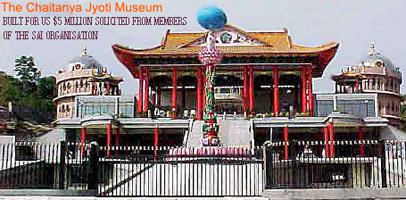
The ‘Chaitanya Jyothi’ is a grand mix of Chinese, Gothic, Moorish and other architecture, with a symbolic number of 7 floors, was opened on SSB’s 75th birthday in 2000 to house yet more exhibits depicting his life, mission and message and ‘glory’. Very considerable expense has been incurred by a number of rich foreign devotees in designing and building rooms for SSB in their home countries on his ‘promise’ to visit them with an entourage. This has been done in Divignano, Italy at ‘Mother Sai House’ (complete with special apartment with Indian bathroom/toilet for SSB) and not least in California at Ojai. Sai Baba has never visited as he has said he would. So as to explain away this it is usually said by devotees to mean that SSB has visited in other ways (‘astrally’ etc.). All these misplaced funds defeat the claim to any ‘ceiling on desires’ doctrine. See http://bdsteel.tripod.com/More/pparthivisit08.htm
I have been advised by a correspondent that, “To understand how the Sai Org. functions we should not underestimate its financial part - Sathya Sai Central Trust. This is the body which accumulates all funds. But the information is very scarce. I haven't seen any document about (i) when it was established, (ii) rules and regulations of its work, (iii) its relations with the Sai Org., (iv) people who run it. In this connection, I quote one piece of typical material from the same letter from I. Shah as above, to Overseas Coordinators on how to obtain donations from devotees:
1) To organise 100 donors for accommodation in Building No. 8 and 9 and for which each coordinator gave their quota for the region which they will fulfil before March 2000. Dr. Goldstein was requested to be in charge for follow up with the Coordinators in this regard.
2) Letters to be written to the Bond Holders by respective Chairmen of the Zone. It was also decided that Bro. Hira should be in-charge of all follow up on this matter.
3) It was suggested that we should not solicit any donation by way of appeal or writing letters or making any announcements, but that the coordinators in their personal capacity should get in touch with known personalities/Sai Devotees and talk about this project to meet with the minimum target of US$50,000- per region which was supposed to be remitted in two instalments viz. before 4th March and 6th May 2000. The simple calculation was to select 50 persons and request for US$ 1,000 from each. To meet this requirement, 50 devotees may be selected from the whole Region. Perhaps it may not be necessary to reach out to all the 50 since the requirement from a particular region could be fulfilled by just a few devotees. However, if any region can contribute more than US$ 50,000- it is welcome, to offset any shortfall from smaller region.”
Concerning the above letter, the President of the Moscow Centre at the time, Serguei Badaev, wrote: I would like to share a case when at the meeting of the coordinators in Germany (it was probably the year before the construction of a new museum of Spiritual Heritage in PN started) T. Meyer read aloud a letter from I. Shah to the audience. The letter stated that funds were necessary for the construction of a new museum in PN and they should be supplied by the world zones of the Sai Org. according to special quotas. For the world zone 4 (Northern Europe) it was stated as US$50 000- T. Meyer was reading a letter as if it was a complete surprise for him. He shrugged his shoulders and expressed his doubts that the world zone 4 including such poor countries as Russia and the countries of Eastern Europe could manage to contribute such amount. He suggested to look for some rich sponsors in Western Europe countries inside the zone and not to bother Eastern block with this matter. This implies at least two points. First, T. Meyer didn't take part in making the decision to build a new museum (unless it is a political game for public). Second, some schemes should exist to approach potential donors for fund contributions to the Sai Org. projects.
Sathya Sai Baba's wasteful use of private jumbo jets for his holidays
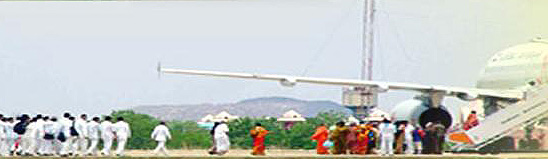
Private hired jet 2006 Sai Baba's private jet - hired to take him 'on holiday' to Kodaikanal in 2005! Around that time, he also announced in a discorse that he was "minded to make a world tour". At the time it was thought most likely another 'bum prediction', and that if he in fact should, it would surely be in another private jet hired with funds given for the poor, education, health etc., The almost unused Jumbo airport cost a small fortune too!
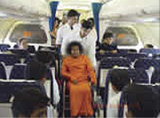
The "Swami" in a private jet yet again in 2006. Such a misuse of donated funds!
Year 2006, holiday trip