THE ABODES OF SAI BABA IN WHITEFIELD ('BRINDAVAN') AND PUTTAPARTHI ('PRASHANTHI NILAYAM')
All is not as it seems to be to the spiritual seekers who visit. Sathya Sai’s original and chief ashram in Puttaparthi, Andhra Pradesh, now the independent township of Prashanti Nilayam - is a fiefdom over which he rules completely. It is supposed to be "The Abode of Supreme Peace" (i.e. "Prashanthi Nilayam") ... a sanctuary from worldly problems full of saintly people. Newcomers who have read some of the many gushing, super-rosy books about Sai Baba’s self-proclaimed perfection, divine purity and his mysterious divine control of his ashrams and the intimate detail of everyone’s lives, expect ‘The Abode of Supreme Peace’ to be either a paradise or - after an initial experience - at least a place where people are more virtuous, kind, fair and civil than elsewhere. Many visitors find it an exotic and new cultural experience
to visit Indian ashrams. At Sathya Sai Baba's two main residences - at Whitefield near Bangalore and Puttaparthi - the ashrams supposedly offer the chance of seeing and being helped or healed a living God man, a self-proclaimed avatar or God Incarnate. Visitors usually arrive with their minds filled with with what most often turn out to be false ideas about 'spirituality'. Many are very enthusiastic at seeing some of the ca. two million religious parasites which infest India - seers, fakirs, soothsayers, astrologers, yogis, nagas, temple priests and diverse swamis. The great majority of them are either naive believers who are practicing a traditional trade craft (under whatever 'spiritual' pretense) or else direct but clever frauds. This has taken place since 1994.
The meaning of the Indian word 'ashram' is a place of 'no hardship' ('a-shrama'). So it is should be a refuge from the cruel world. However, it is far from being any utopian retreat! The forceful, pushing crowds, the discriminatory culture (VIPs or nobodies and all in between), the physical, mental and emotional hardships one is made to suffer all help to ensure that. Visitors hope to be accepted by Sathya Sai Baba very seldom tell things are they really are there, warts and all. Unlike those who – knowing no better - paint wholly unrealistic and imaginative pictures of the place and what goes on there (such as your present author, alas, did in one of the books he has published). Those who in one way or other happen to have penetrated behind the scenes or the many deceptive appearances and calculated disinformation, discover many a sad fate there and all manner of untoward incidents and very carefully covered-up crimes and deceptions.
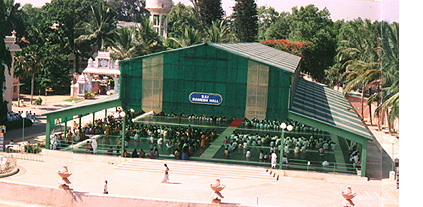
A Day in the Life begins very early – one must be up and queuing at least by 5 a.m. to have a chance of getting near to the ‘darshan’ area. The process can be extremely trying, as countless visitors always complain privately. The women, the predominant mass of whom are Indian - but also certain Southern Europeans and Southern Americans - often stand up and may trample their neighbours when Sai Baba approaches. He once complained to his Seva Dal ladies that they behave "like wild horses". Overweight females often block the view of others and one must be careful that they do not tread on ones feet, hands or laps. They will squeeze into tiny spaces between people, then expand for space and sprawl over their neighbours. Indian women are especially given to chatter during darshan. They can be extremely impolite and selfishly arrogant when approached about it, not a blush nor a batted eyelid. The men are more disciplined on the whole while young Indian villagers, Italians and Argentinians probably rate highest as a pushy, selfish nuisances. A few of the itinerant 'sannyasins' or their imitators smell so badly from their pungent breath and choking body odours that to sit beside – or even near to – them (which most will avoid at any cost) is a torture.
Since the alleged 'assassination attempt' on Sai Baba. no one has been able to take in any object large or small that could remotely be used in any way to cause any physical injury to…. ah well, to whom? Now who would anyone want to attack precisely with a pencil, a pen, a floppy disc within the darshan compound? Good question! Both men and ladies are body frisked thoroughly and quite invasively too!
Among the male invalids, who stand for up to 1 or 2 hours despite their frailty so as to get to sit on one of the too few uncomfortable chairs, there are pushers, line-cheaters and No 1 Egos who often succeed in running ahead to bag the best places day after day, leaving the weak, the blind and the infirm to stagger to a rear seat (if they are in luck!). Those invalids who still have enough physical stamina to march on the early morning bhajan-singing ‘nagarsankirtan’ cannot get to the front of the standing queue for the invalid chairs, for the queue will already be formed and long by the time they have finished. Invalids who are not selfish and who show respect for others’ problems almost always end up in in the rearmost seats. Inside the darsan compound, invalids are now relegated to most uncomfortable stone benches along the insides of the outer walls.
People who frequent the ashrams and environs Quiet!
Among the usual seekers, there are probably more simple, disoriented, emotionally stunted and suffering people visiting Sai Baba ashrams than anywhere else. More than any of the apparently less confused (but equally deluded) followers will openly admit
or ever write about. Prashanthi Nilayam is spoken of as a kind of social paradise, an oasis in a disturbed and evil world. That is very relative, for inside its walls there are seldom deformed and pitiful beggars, few itinerant priests, only the occasional pressing
salesmen or other such disturbances which are common on the streets throughout the land. But Prashanti Nilayam is definitely
not the alleged "Abode of Supreme Peace" for the visitor - no sanctuary from
worldly problems nor a place full of saintly people. As a retreat it is not an utopia... not by any means, for it is a place of both physical and
mental-emotional hardship for many visitors (the prices of rooms
have increased from almost nothing to very considerable sums, but one can now live in fairly luxurious hotel rooms and chalets in the area, which is the centre of a property boom like a market tornado). One elderly
Indian devotee I knew, Mr. V. Ramnath, a Vigilance Officer in the Indian Administrative Service, who knew many ashram
residents and visitors assured me that it is "a snake pit of jealousy". I have witnessed
many incidents which support this description. The previous Head of Vidyagiri Administration
for over 20 years, Mr. Kanhaia Jee, informed my wife and I that the key staff are forced to stay all year round and that they fight like dogs when Sai Baba is away or they think he is unaware of them! And the ever-present pi-dogs fight viciously and nightly within the ashram.
Apart from the hope that being near to the self-proclaimed God will confer spiritual gifts and blessings, there are some other attractions of ashram life for foreigners. One is the great change of culture, climate, food habits etc. involved (until it becomes too familiar). There is often (not always) a lack of stress and deadlines. Life there is still slower and closer to non-industrial society. It can also be fine to isolate oneself thus from the world, its media and constant depressing news. Part of the visiting experience is to meet culture and the people rather than suffer the usual alienation of mere tourism. It is instructive to persons who have seldom stepped over cultural boundary lines before. Despite the enormous physical and social problems in India, one can meet smiling faces among even the poorest of Indians, who would seem to have little to be happy about - few material goods, health benefits or social compensations.
The good, the bad and the indifferent followers
Since I first visited Sathya Sai Baba in 1984 I met quite a lot of good persons in the Sai movement, some fairly
prominent in their walks of life, and some of them well educated...
some were helpful, solicitous and generous minded. Unfortunately I have to say that this was definitely not true of the majority I met or observed! Sai Baba attracts a relatively large number of people of little spiritual understanding,
both as regards common sense and and human insight. But and also in so as far as their
behaviour spoke. One may argue that it is necessary for Sai Baba to
attract a great many who need to be changed, or to
change themselves, if the world is to become a better place.
In any crowd 'sitting at Sai Baba's feet' there'll invariably be a wide range of persons of many shades of opinion, with conflicting attitude, opinion and also behaviour. It would be wrong to deny that many people at the ashrams behave with strong egoism and are insensitive to others... push and shove is the norm rather than the exception! People are at all stages of development, of course, coming from a great diversity of backgrounds and conditions. It was always surprising to European devotees I knew how few people showed common decency in various ways, from personal conceit to lack of honesty and kindness in action.
It seems fairly reasonable, in a way, that Sathya Sai's self-declared task of improving society and the world through transformation of individuals would call for him to permit all kinds of person to come there, not only those who act well and for the good. Especially if he is to have any positive influence on those in India who are its biggest problem... This might just explain why he gives interviews both to known criminals in India and accepts their money, but also to foreign leaders known as major criminals (e.g. Idi Amin of Uganda, Bettino Craxi of Italy). He also emphasizes that physical proximity is no guarantee of a person's character and nor is long residence in the ashram either. Many people's observations tend strongly to agree with this.
Jealousy in the snake pit One elderly Indian devotee, an Indian Administrative Service Vigilance Officer -V. Ramnath - who wrote the excessively hagiographic book 'Waiting for Baba' - had long experience of the ashrams and many officials and residents. He assured me it is "a snake pit of jealousy" (but like all Sai hagiographers he carefully omitted all of the many negative facts he told me from his book). A previous Head of Administration in the Vidyagiri building for over 20 years, Mr. Kanhaia Jee, also related to my wife and I many hidden incidents and unspeakable home truths about the ashrams - not least that the 'Abode of Peace' staff "fight like dogs" when Swami is away or his back is turned! Ramnath told us many of his experiences of people around Sathya Sai Baba, including friends or relatives of his (a number of whom we visited with him)- including high officials in the Indian administration and in Sai institutions. He said that many who get a permanent apartment at the ashrams believe that - being within the area of ‘divine vibration’ - their spiritual development is ensured and they have thus done everything required for salvation from the wheel of life. They just go to darshan, shop, make good dinners and their lives are empty of social or other useful meaning, waiting for blessing to fall like ripe fruit into their laps. In the continual rat-race to ‘attain Swami’s feet’, otherwise fairly virtuous persons become like piranhas, very jealous of those who get interviews or other ‘grace’, whom they libel through back-biting. This view is supported by several talks Sai Baba has held, both in public and not least in very strict correctives to the assembles Seva Dal in the various ashrams, for example:- ‘Residents of ashram have derived little benefit’ Sathya Sai Speaks Vol. 27, p. 78: ‘Residents at ashram who have aged but not grown’ Sathya Sai Speaks Vol. 10, p. 28: and ‘Seniority imagined by long-term residents’ Sathya Sai Speaks Vol. 5, p. 306).
The degree of bitterness and recrimination is sometimes so intense that it is incomprehensible that the guilty can even pose as followers of Sathya Sai Baba’s teachings. To my knowledge, battles for domination of a Centre or National Council among those who take up office in the Sathya Sai Organization have raged for years in the UK, in Holland, Eastern Europe and Russia, Venezuela, Argentina, Colombia and not least India… to name some, battles for prominence which are if anything intensified at the ashrams (e.g. in the run-up to darshan) where gaining privileges and interviews is the main aim of most ambitious office-bearers. Those who strive in all ways to become important in the movement are mostly self-important, self-seeking and often uncivil persons who one should avoid entirely. Most of the Central Coordinators are like that, unless one treats them as superiors all the time and never asks difficult questions.
The comic is carefully excluded from accounts: One will not read (except here) of even minor events such as when omnipotent Sai Baba was made to fall full length on the concrete by a male devotee who flung his arms around his ankles while he was moving? The man who did it got his head beaten severely against the concrete by Sai Baba’s attendants! (Love in action?). No one wrote about a foreign lady who made a spectacle of herself in front of 'the avatar' by running out of the ordered lines and lying down on her back and heaving her body while shouting “I will give birth to the next avatar!” Or that a young Danish lady daily stripped naked and ran around the ashram shouting ‘Love, love, love!’ while none of the servitors dared to go near her for days.”
Staff and treatment of visitors
Quite a few of the ashram
staff show good qualities as one would expect. However, this also serves to emphasize the deficiencies of
behaviour and understanding of many other staff or helpers there. One soon realized that visiting devotees are 'ranked' by
those of the officials who cherish warped ideas about the relative importance of
people and show it through their authoritarian or patronizing behaviour. To
many foreigners, especially from well-ordered Westernized societies, it comes as an unexpected disappointment that this
occurs at all in the proximity of Sai Baba, for it seems wholly alien to
his teaching and the spirit of love. Such attitudes, however, are
really little different to those prevalent in most societies, and
not least in class- and color-conscious India, where compensatory superiority feelings towards Caucasian people (whites) is often met [even though the lighter the colour of one's skin, the better price a female can exact on the marriage mart in India!].
Seasoned visitors have had to put up with bossy or obstructive 'servitors' patiently for years on end. Many treat foreign visitors as subordinates or inferiors. New visitors to the ashrams - especially all non-Indians - find themselves part of the 'rank and file', whereby anyone who desires to be present at darshan must sit in strictly overseen ranks and file according to the behest of the many orderlies or security men. In a discourse published in Sanathana Sarathi for July 1996, Sai Baba read the riot act for the ashram people and residents... accusing some staff of being Alsatians. Some time prior to this, a lady who had been at an interview told us how an English lady had asked Sai Baba, 'How are your dogs?' He had replied that he had no dogs. 'Yes you do, a Rottweiler and an Alsatian in your offices!' I would, however, add that the work done by those who receive visitors to the ashrams is often quite demanding and a few years of it would probably reduce almost anyone to a fox among chickens. Some do surmount the challenge and remain courteous and friendly at all times, which is admirable!
Most visitors soon learn to knuckle under - the threat of being side-lined or even excluded from the ashram is strong because one may have travelled half the world to try to get the opportunity of meeting Sai Baba. An attitude of humility is adopted by many, though some will not be cowed by unreasonable demands and restrictions... and they soon end up blacklisted from visiting the ashram again by the staff. There is something basically wrong in being like a rabbit frozen in the glare of some headlight, but that feeling is induced in most visitors who want to show that they are minimizing their egos, behaving with forgiveness, and generally 'passing the guru's test' of not being defeated by adverse events.
Sai Baba plays the role of the master, turning this devotee humility and subservience to his own ends - playing upon every kind of human weakness to put devotees down and keep them in submission and surrender to his unceasing demands of worship and support under all and every circumstance, whatever it may involve. There is an other kind of humility than fear and servility. It is inspired by recognizing one's own reality and nature as a person with conscience, love of truth and goodness, plus one having the freedom and responsibility to act. This does not mean conceited rejection that anyone else can know more or be better than oneself, but it requires that we retain the integrity of our autonomy - our own truth. The birthright of our supposedly God-given intelligence and autonomy - and our own potentialities - are all too often projected outwards onto some charismatic figure who constantly demonstrates that he is certainly not at all everything he claims to be!
Foreign ashram residents Foreign devotees often live long periods or permanently develop a kind of ‘residential patina’ which - along with carefully adopted Indian traits like perfect use of saris and Indian customs and rituals - is mixed with outwardly condescending attitudes towards newcomers. Despite being old hands knowing all the tricks of the trade, they still have to suffer all the scouring abrasions they regularly get from the native ashram powers-that-be, and from members of the Seva Dal. I have never heard of more than an exceptional few of these permanent fixtures doing anything except take care of their own quotidian affairs… no service work, no proper study or self-discipline… just following the routines, always knowing how to ‘cut corners’ and generally get ahead of others. I have accompanied many to Prashanthi Nilayam as group leader and found that very few foreign residents there were at all helpful in giving a helping hand to newcomers. In recent years, since the scandals took over, most of these foreign residents have been treated abominably and most driven out of the ashrams where they had planned to remain forever.
Does ashram life really increase
spirituality?
There is a basic contradiction about Sai Baba ashrams - they are supposed at the same time to be a place of refuge from worldly hardships and a testing ground for how many hardships one can overlook and withstand! It is well-known to be a place of both physical and
mental-emotional hardship for many visitors... though material conditions have improved vastly since the 1980, as billions of dollars have poured in.
The etymological origin of the word 'ashram' is a place of 'no hardship' ('a-shrama'). So it is a intended as a refuge from the cruel world and its many problems. Many foreigners who stay there as long as they are allowed tend mostly to laze about and indulge themselves in doing little or nothing other than follow the daily routines, shop, tour around and even visit cafes and restaurants outside the ashram. Contrary to this, Sathya Sai Baba proclaims that it is futile to stay there if one is not doing service (Sathya Sai Speaks new ed. Vol. 26, Ch. 7, p.79f), disciplining oneself and changing one's attitude (Sathya Sai Speaks new ed. Vol. 16 Ch.28, p. 157f) while rigorously searching for truth. How one might find truth there rather than elsewhere and in the world is an unanswered question.
Of the many people I have met
at Sai ashrams and in Sai centres in several countries, not one has impressed me as being anywhere near 'the truth' in the sense of being an illumined person, unhindered by social or mental-emotional attachments, capable of deep insight, impressive understanding or of obvious sterling human qualities in action. On the
other hand, I have met more peculiarly confused, unrealistic and suffering
people in the Sai movement than in any comparable connection, and not least ignorant and arrogant persons who think they know a lot they clearly do not.
Manipulation of people: flattery and 'hypnotic' suggestion are powerful tools.
Quite clearly the majority of Sai devotees are incapable of resisting the prevailing group pressures and promised enticements of faith in him. Those who take flattery completely at face value, and seek more of it (from 'God Himself'), will surely fall victim to his charisma. Such persons are easily handled by the method of repeated attraction/repulsion, the psychological ‘push-pull’ treatment which keeps them uncertain but still attached in hope of greater things. If such things very seldom – if ever – actually come about, they can be rationalized away by self-deprecation or appeal to the inscrutability of such a divine spirit. This occurs with the great majority of Sai devotees I have met, and that is a lot. Due to his intuitive powers and long experience through trial and error in maintaining the illusions of his own chosen role, Sathya Sai is very clever at manipulating what a person’s condition is, what he can be shown and what not. In this he is capable of the kind of influence over people’s minds and perceptions. The role of suggestion is absolutely central to this, and it is an amazingly subtle and powerful tool, particularly when exercised within an environment which supports the total belief and surrender to Sai Baba's and his claims of omniscience as an all-knowing God Incarnate. Suggestion is at the very core of what has usually been called hypnosis - especially mass hypnosis. The kind of manipulations of people’s minds and perceptions Sathya Sai Baba achieves is also done by others to an equally high degree, though they do not mystify themselves or their techniques. Such as the way people are induced into immediate trance conditions by the most extraordinary well-known TV personality Derren Brown of UK’s Channel Four, who claims there are no psychic powers involved, but only highly developed techniques of mind control. Likewise the much respected US therapist, Milton Erickson whose abilities as a therapist using techniques like suggestion and confusion could transform people (see here) and other impressive 'illusionists' who employ intricate and quick-acting suggestion on stage (Paul McKenna, Dave Knight).
Living Conditions in the ashrams
Dry dust is a major problem at Prashanthi Nilayam, especially when there is wind. Daily, however, sweepers with switches raise the dust with great thoroughness, so it pervades rooms and settles all over, even within zipped hold alls and locked cases. Germs are carried on it so that illnesses spread easily. Formerly, when all the compound was of sand, the problem was most invasive, but tiling and concreting has improved some of the most frequented parts of the complex.
The 60th birthday, when the dust clouded permanently up to and above the heads of the crowd, resulted in estimated 80% of those present getting influenza and/or severe stomach complaints with diarrhoea. Also very unhygenic are the open food waste bins which are visited by monkeys in troops and dogs which are ever leaving behind large curls and spirals of faeces as their ‘visiting cards’. The 70th birthday was also mostly celebrated within a huge cloud of dust…
At Prashanti Nilayam, dogs battle it out in twos, threes or large groups – day and night – reminding somewhat of certain groups at darshan or in canteen and other queues. At intervals, when Sai Baba is away and there are very few foreign residents present, the dogs are netted and taken away in scores by lorry and dumped in the wild (it is said). Anyone who dares to take a photo of this trapping of dogs – they wail very loudly – can be blacklisted from future visits, as happened to a Romanian-Norwegian lady we knew in the 1990s. Dogs are supposed to be sacred to Shirdi Sai Baba and hence to Sathya too… so this treatment of them must be covered up, like any other matter which could show up the shams that are all too common there. Troops of monkeys ravage wherever they can enter - such as in the accommodation sheds, and a bite or scratch from them can give rabies. They are free to sort in the waste food containers which are left open all around the ashram.
The 60th birthday, when the dust clouded permanently up to and above the heads of the crowd, resulted in estimated 80% of those present getting influenza and/or severe stomach complaints with diarrhea. Also very unhygienic are the open food waste bins which are visited by monkeys in troops and dogs which are ever leaving behind large curls and spirals of faeces as their ‘visiting cards’. The 70th birthday was also mostly celebrated within a huge cloud of dust.S
The 'hardships' Sai Baba recommends
Someone who once complained of
the hardness of the cement floor he had to sleep on was told by Sai Baba
that he instructs by life in the ashram, to bed early and up early keeps
the mind bright and alert and shows how little the body needs. (Conversations
with Bhagavan Sri Sathya Sai Baba by Dr. J. Hislop, new ed.,
p. 170) Since the 'bright and alert' people seem to be exceptions at
his ashrams, in what else might the 'spiritual benefits' consist? The
body's basic needs for healthy food and hygiene, some undisturbed sleep,
relief from oppressive heat and so on remain, and it takes about treble
the amount of time and energy to fulfil these needs as in any properly
equipped modern flat. So most of the time left over from following the
daily routines has to be spent struggling with simple tasks of
day-to-day living. There were continual difficulties due to a lack of
material comforts, but this improved a lot since the ashram became modernized
in the 1990s. Getting used to the different rhythm of daily doings can
be demanding, especially for elderly devotees and those suffering from
illnesses and chronic conditions. Many things done easily at home, such
as obtaining necessary items or getting correct information can become
long labours in the ashram. This is all supposed by Sai Baba to be for the
benefit of the devotee! Those who 'own' rooms (i.e. who can lock things
away in their kitchen for the 10 months each year when they are not
allowed to be there), invariably return to a worn-down apartment with
broken fittings and very often filthy conditions left behind by the
many and various guests. My wife and I have had to clean one disgusting
room after another almost every time we have stayed there. Such 'selfless
spiritual service to the Lord' is supposed to be morally elevating etc.,
but it seems more like drudgery from which the majority of those visiting
'spiritual seekers' who cannot be bothered to clear up their own dirt
will never learn anything!
Avoidance of all unnecessary contacts, friendships etc.
Sathya Sai Baba does not at all favour social contacts while staying at his ashrams. One is supposed to keep to oneself, observe silence whenever and wherever it is not essential to speak. However, his warning is ignored totally by the great majority of visitors - unless during darshan, when servitors stand by to shush anyone who talks aloud. Learning what one can and cannot do is difficult for newcomers, because there are notices all over the ashrams which hardly anyone heeds, there are many unspoken rules which one learns mostly through offending against them (where to walk, when on can go here or there, what one can or cannot wear (eg. sandals, insufficient coverage of ladies etc.) It is a trial and error affair. Sai
Baba has spoken out strongly and often against making contacts or
friendships at his ashrams - especially between the sexes. That one cannot demonstrate martial affection in public or be seen to hold hands with anyone of the opposite sex is fair enough, since the extremely traditional views on the relations
between the sexes Sai Baba propagates is held dear by many of the regular ashramites.
Why quash social contacts and
reduce friendships?
It is clear that Sathya Sai Baba wants to exert maximum control over his servitors and, partly through the and partly through his 'teachings', also of his visitors. There are unstated reasons for his trying
hard to reduce open social contacts to a minimum and require silence whenever
feasible within the ashram. He gives constant warnings against against talking unless strictly
necessary and especially against talking much or often! It is only evident to those who have much experience of India and ashrams, and especially of the Sathya Sai movement, that these attempts to stop fraternizing, sharing information and telling what one knows to others about events, and even about Sai Baba himself aim to censor anything that is untoward and cover up as best they can anything that may get out to the public about crimes and deceits, which take place just as much (or more) than in the Indian environment generally. Only by happenstance do alarming discoveries cause anyone to question anything (questions of anything questionable are almost never answered, or are avoided. One may even be told strictly to mind one's own business, or words to that effect!) Few people can begin to know from their own experiences - which remain very limited as to the workings of Sai Baba's set-up - the depth
of the deceits practiced by him and his officials. This is one reason for this web site, of course.
Most devotees tend to see the
world mainly in black and white terms.... and demonstrate their ignorance of' the colours'. This trait is clear also in
Sai Baba , as all acute observers who read his discourses will quickly learn. Most
followers in the experience of my wife and myself become
- under Sai Baba's long-term
influence - gradually much more religiously fundamentalist (and are all too often moralistic despite Sai's advice not to criticize others) In
his discourses he constantly propounds moral
values at a simplistic level and to suit the mentality of people
lacking in a good upbringing, normal fellow-feeling, personal integrity and common
decency. That fact speaks its own story! Oddly, people of that kind are also quite often given privileges and high
positions by Sai Baba, not least in
his selection of unpleasant and domineering higher office-bearers in the Sathya Sai organization.
It is not irrelevant to point out here that most Indians have a very exaggerated belief in the value of letters before and after their names. Many pile on the letters in series, whatever significance they may or may not truly have. Many such degrees and positions have in decades past been obtained by the traditional right of high castes of good family to pass examinations (or else the professors will suffer for it!) or also by outright nefarious means (I have been on a committee at the University of Oslo to try to decide on cases of suspected fraud by foreign students applicants, and Indian degrees were sometimes 'home-made' on bogus paper with slightly awry printed headings etc.)