SAI BABA PROMISES TO VISIT ABROAD - BUT NEVER AGAIN LEFT INDIA
where he enjoyed the legal protection of the Indian Judiciary and the Government.
Sai Baba stated in 2005 that he was "minded to take a world tour". Yet he had always pledged that he could solve India's problems before ever would go abroad It is well recorded how Sathya Sai Baba told leading devotees on several occasions that he would visit them in their countries - for example USA, Italy, U.K., Southern California and other places - but then he has changed his supposedly all-knowing mind, saying that India must be cured first!
The case by sexually-abused Alaya Rahm against Sai Baba and the Sathya Sai Society of America was heard by Judge John M. Watson of the Superior Court, County of Orange, California, on April 28th, 2006. He ruled that Sai Baba in India could not be indicted from California as it did not have reciprocal jurisdiction rights against an out-of-country defendant. Alaya Rahm's advocate could not therefore use California state subpoena powers as the defendant was not subject to the powers of the Hague Treaty. Had Sai Baba visited the USA then or thereafter he would have been in jeaopary of subpoenas and lawsuits against which the Indian government would most likely not have been able to protct him. A number of his sex abuse victims were US citizens, so he did not risk a visit there, even had he intended one. Much the same applied to other countries outside India.
Very considerable expense has been incurred by a number of rich foreign devotees in designing and building rooms for SSB in their home countries on his ‘promise’ to visit them with an entourage. In the 1990s, Robert Baskin built a mansion to house him on his promised visit to Ojai, California. Of course, he never went to the USA! So as to explain away this it is usually said by devotees to mean that SSB has visited in other ways (‘astrally’ etc.). Further an Italian VIP devotee built a ‘Mother Sai House’ and, when shown photos of it, he called for the rebuilding of his private toilet because it was not to his liking - i.e. it was European style and not hole-in-the-floor. I was shown the luxurious one.holed teak-floored result by the owner, Pietro Marena when we visited there for a European Sai Conference in 1991. All these misplaced funds defeat his claim to pu a ‘ceiling on desires’, which he demanded of all his devotees. doctrine.
See http://bdsteel.tripod.com/More/pparthivisit08.htm
So Sai Baba was a hotbed of contradictions, false predictions and outright lies, surely anyone with reasonable clarity of mind who looks into it can realise that?
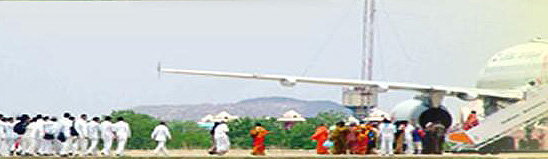 Sai Baba's private jet - hired to take
him 'on holiday' to Kodaikanal in 2005!
Sai Baba's private jet - hired to take
him 'on holiday' to Kodaikanal in 2005!
Sathya Sai's "minded to make a world tour". At the time it
was thought most likely another 'bum prediction', and that if he in fact should, it would surely
be in another private jet hired with funds given for the poor,
education, health etc., The almost unused Jumbo airport cost a
small fortune too!
And here below is the palatial "Divine Residence" -
one of his many, probably the best...
Again we saw him in his
wheelchair in his hired private jet in 2006. The waste/misuse
of donated funds!
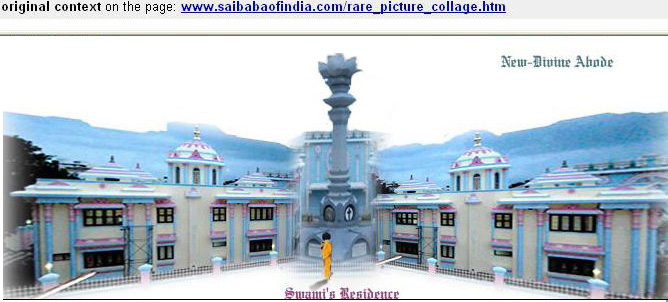
In 2007, Sathya Sai Baba moved into a brand new residence complex . the Yajur Mandir -
built for
him
within the ashram with bigger and better luxury at Prashanthi
Nilayam.
