UNRAVELLING THE
ENIGMA
- SHIRDI SAI BABA - IN THE LIGHT OF SUFISM
by Marianne Warren
Sterling Paperbacks - New Delhi Revised edition 2004 - ISBN 81-207-2147-0
 (Publisher's
presentation): Marianne Warren's new work is an exciting
new piece of research which examines Sai Baba of Shirdi from the
standpoint of Islamic mysticism - the Deccani Sufism of 19th century
Maharashtra - in order to unravel the mystery surrounding the saint.
Sai Baba is consistently described by his Hindu biographers as a
' Muslim faqir' and a mystic, which, by definition, makes
him a Sufi. However, no previous researcher has examined him thoroughly
in this light. The author assumes the reader will have some familiarity
with previous biographies of Shirdi Sai Baba and reviews incidents,
anecdotes and sayings of the hagiography surrounding Sai Baba, in
the light of the goals, practices and stories of the Sufis from
the golden era of Sufism, and discovers that an amazing similarity
and correspondence begins to emerge. Immediately, the more puzzling
aspects of the saint's actions and sayings fall away, and Sai Baba
himself becomes more understandable, attractive and lovable.
(Publisher's
presentation): Marianne Warren's new work is an exciting
new piece of research which examines Sai Baba of Shirdi from the
standpoint of Islamic mysticism - the Deccani Sufism of 19th century
Maharashtra - in order to unravel the mystery surrounding the saint.
Sai Baba is consistently described by his Hindu biographers as a
' Muslim faqir' and a mystic, which, by definition, makes
him a Sufi. However, no previous researcher has examined him thoroughly
in this light. The author assumes the reader will have some familiarity
with previous biographies of Shirdi Sai Baba and reviews incidents,
anecdotes and sayings of the hagiography surrounding Sai Baba, in
the light of the goals, practices and stories of the Sufis from
the golden era of Sufism, and discovers that an amazing similarity
and correspondence begins to emerge. Immediately, the more puzzling
aspects of the saint's actions and sayings fall away, and Sai Baba
himself becomes more understandable, attractive and lovable.
In the book. Dr. Warren brings two new pieces of scholarship to
the subject. First she elucidates the English translation of part
of the works of some l7th and I8th-century Maharashtrian Sufi poet-saints
- their contribution having hitherto been neglected by scholars.
Their lives and writings echo the life and teachings of Sai Baba.
Secondly, she includes the English translation of the previously
untranslated Urdu notebook, jotted down by Abdul, Sai Baha's faqiri pupil, from teachings based on the Qur'an given to him by his pir Sai Baba. Both these contributions allow us to see into a world
hitherto closed, and expand our awareness of the famous miracle-worker
of Shirdi. While Sai Baba has attained a universal appeal, transcending
any one sectarian religious tradition, it is necessary to understand
his Sufi origins in order to obtain a deeper and fuller appreciation
of the enigmatic saint of Shirdi. Read review by P.D. Shastri at http://www.tribuneindia.com/1999/99oct24/book.htm#3 (if unavailable, click here)
--------------------------------------------------------------------------------------------------------------
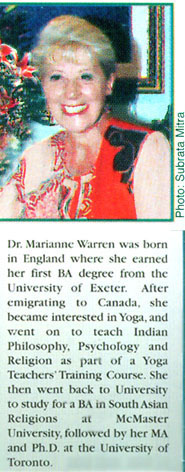
Dr. Marianne Warren died in September, 2004, a great loss to the
sphere of independent and original academic research into the life
of the Sufi saint. She taught Hindu Studies at Toronto University
and, together with her husband, ran the Sathya Sai Baba Bookshop
in Toronto for many years. They eventually moved to Mexico, where
Marianne wrote an up-dated version of her book in which she authoritatively
exposes some of the distortions made about the life and predictions
of Shirdi Sai Baba by the deceitful Sathya Narayena Raju ("Sathya
Sai Baba"), who claims to be Shirdi Sai Baba reincarnated. Click
here for further information on this book
Marianne Warren had plans to write a book exposing Sathya Sai Baba - together with me (Robert Priddy) and another Sai-exposé writer. However, she wrote a draft introduction to the issue she wanted to cover in the proposed book, and it is very instructive. Her ground-breaking work on Shirdi Baba remains as a valuable correction to myths about him now current in the Sathya Sai movement. It may be a solace to those followers of Sathya Sai Baba who are becoming able to realise the complete falsity of many of his excessive 'avataric' claims that any connection he supposedly had to Shirdi Sai Baba is now cast into severe doubt. Marianne Warren's introduction to the proposed book succinctly sums up her mature viewpoint on this alleged connection:-
An Introduction: 'Sathya
Sai Baba - Godman or Conman' - projected book contribution by Dr.
Marianne Warren
In my book Unravelling the Enigma - Shirdi Sai Baba in the Light
of Sufism, published in 1999, I outlined my intention to write
a further book to incorporate theclaimed inter-connection between
the two Sai Babas - the Maharashtrian saint, Sai Baba of Shirdi with
the contemporary godman, Bhagavan Sri Sathya Sai Baba. Due to a variety
of reasons, which I will explain later, I felt it unsuitable to include
the statements of Sathya Sai Baba regarding the Shirdi sage in this
book, but the most compelling was that they are not independently
verifiable.
When he was still quite young, an Indian boy,
Sathyanarayana Raju, claimed to be the reincarnation of a well known
nineteenth century Muslim miracle-worker known as 'Sai Baba', who passed
away in 1918. So insistent was this boy that he was this saint reincarnated
that he became known locally as Sai Baba, and to differentiate between
the two Sai Babas, became known as Sathya Sai Baba. Over the intervening
decades an extensive corpus of material had accrued from statements
made by Sathya Sai Baba relating to this earlier figure. These two,
the nineteenth century Indian saint of Maharashtra and the current Swami
residing in his ashram in Puttaparthi, Andhra Pradesh both bear the
name 'Sai Baba', and the two have become inextricably linked in the
minds of many of Sathya Sai Baba's devotees. However, this linkage is
not apparently the case with devotees of Shirdi Baba either in Shirdi
itself or throughout northern India, many of whom are violently opposed
to the reincarnatory claim of Sathya Sai. So this is a one-sided connection,
as Shirdi Sai Baba never anticipated any future incarnation of his own.
Indeed, he intimated that he would have no physical successor, and furthermore
that he would be subtly present after death to help his devotees. This
attitude is commonly accepted in western India, where both the essence
and healing powers of a Sufi saint are felt to remain and be active
in his dargah or tomb, even after the passage of hundreds of years.
This theme will be explored further in the chapter on the Shirdi Sai
claim.
Sathya Sai Baba, however, has constantly invoked the name of the earlier
saint Shirdi Sai Baba from age thirteen or fourteen onwards. According
to the official biography, it was in 1940 when he first made the announcement
that he was the reincarnation of this saint, being born in 1926, eight
years after Shirdi Baba passed away in 1918. These dates are now in
dispute as will be discussed in a later chapter. However, Sathyanarayana
Raju took the name 'Sai Baba' adding it to his own, forming his now
familiar and famous title, Sathya Sai Baba.
On the other hand, much of what Sathya Sai Baba has stated about his reincarnation of Shirdi Baba cannot be independently verified, so this material has to be classed as hagiography and indeed takes on a mythical or even puranic quality. Thus, for my thesis, I excluded all of the material which originated from Sathya Sai Baba, although it is sometimes difficult to distinguish what is original and which part is Sathya Sai Baba's version of, for example, the parentage and birth of Sai Baba of Shirdi. So much of the later Swami's version has become integrated into the accepted hagiography, and is then endlessly repeated in the secondary literature. Since there is a certain amount of material still extant on the Maharashtrian saint, I decided to concentrate on writing about this saint alone, and exclude unverifiable claims made by Sathya Sai Baba. In addition, it is very difficult and even libelous to write critically of someone who is still alive. My book, Unravelling the Enigma - Shirdi Sai Baba in the Light of Sufism, therefore, contains only a short chapter called 'The Sathya Sai Baba Connection', which briefly outlines a few salient points.
Although one sees the familiar figure of Sai
Baba of Shirdi with one leg crossed over the other, all over Maharashtra
in taxicabs, auto-rickshaws, wayside shrines, pavement artists' drawings,
small altars in stalls and shops and many other places, in fact my initial
interest in the Maharashtrian Sai Baba sprang solely from my interest
in the contemporary Swami Sathya Sai Baba. This claim of reincarnation
was a fascinating piece of information to me - for someone not only
to know who he was in his previous life, but apparently to remember
it all. However in this case the reincarnation of the Shirdi saint as
Sathya Sai Baba was more amazing as he claimed that he did not have
to perform any sadhanas or spiritual practices in this present life,
even as a child, in order to reclaim his powers acquired in the Shirdi
form. He declared that he was an avatar and came with full divine powers.
Further, he announced at a later time that Sri Sai Baba of Shirdi was
the first part of a triple incarnation being the descent of God in human
form. Such a claim is totally unprecedented in the extensive literature
on reincarnation. According to Sathya Sai Baba, he himself is the second
part and a third incarnation forming the triple avatar is to be called
Prema Sai, who will be born in 2030, eight years after the death of
Sathya Sai. The broad scope of this vision is so breathtaking, and the
claim of such a magnitude that one cannot conceive of anyone making
such a spectacular claim unless it was true. Certainly millions of Sathya
Sai devotees think so. In later chapters these claims will be put under
the microscope to see if they stand up to detailed scrutiny.
In the circumstances described above, it is surprising
to find that there is no mention in the Shirdi Sai literature of an
avataric mission. The Maharashtrian saint does not appear to have been
aware of a future triple avatar, and in fact he personally never described
himself in these terms, although his Hindu devotees occasionally termed
him an avatar, but more as a mark of their esteem, than a literal designation.
If this was a God-inspired, God-planned descent into three physical
incarnations spanning 250 years as claimed by Sathya Sai Baba, one might
expect some awareness of the fact from Shirdi Sai himself. But the sage
makes no reference to such a mission or role. This is but one of many
discrepancies and anomalies between the extant literature on Shirdi
Baba and the way he is described by Sathya Sai Baba. Sathya Sai Baba
goes further, claiming that Shirdi Baba was the incarnation of Shiva,
that he himself is an incarnation of Shiva-Shakti and that Prema Sai,
the third and future incarnation, would be Shakti alone. This would
be a magnificent idea if it had fitted, but Shirdi Sai was a Muslim
mystic who showed no awareness of his cosmic powers as Lord Shiva of
the Hindu tradition. No wonder then that Sathya Sai Baba has emphasized
the Hindu characteristics of Shirdi Sai Baba, bestowing on him a Hindu
birth, and other Hindu features. One of the most glaring errors I discovered
is that in a full-length painting of Sai Baba of Shirdi in the Prasanthi
Nilayam mandir, he is depicted as wearing an orange full length robe.
This is a color that only Hindu sadhus would wear, but Sai Baba of Shirdi
was a Muslim. Muslim faqirs would only ever wear white, and extant photographs
of him confirm this to be true. I will expand on these and other discrepancies in a later chapter.
The idea for a second book incorporating what
Sathya Sai Baba had said about Shirdi Sai Baba, was therefore rattling
around in my head so to speak, around 1999-2000, when devastating news
came in the form of revelations made available on the Internet. In April
2000, these revelations were published under the innocuous title of
"The Findings". The Findings were a collection of stories,
affidavits, letters etc., compiled by David and Faye Bailey from ex-devotees,
and revealed various hitherto unknown or hidden aspects of Sathya Sai
Baba's behavior and practices that were fraudulent and sexually explicit.
There were strong allegations of homosexual pedophilia. These revelations
brought an instant response from myself and my husband, as well as many
others around the world, to distance ourselves as soon as possible from
the Swami. We had been volunteers in various aspects of the organization,
but dropped these activities immediately. Few could credit that Swami
who had repeatedly declared his Divinity could be involved in these
dreadful acts, but evidence soon mounted. The content of The Findings
and subsequent revelations is the subject of this present book.
This book therefore is not the work I originally intended to write.
As a result of all the investigations, research, allegations and revelations,
I present this document as objectively as possible, as a warning to
those who may discover the literature on Sathya Sai Baba and all the
extraordinary claims, and are tempted to believe it.
Read further comments
It is also informative to read
on the front page of the Mumbai
Mirror of January 11, 2006 that: Followers
of Sai Baba file case against devotees of Sathya Sai of Puttaparthi
to restrain them from calling him a reincarnation of the Shirdi seer by Manoj R Nair.
Further, comments on this by Indian devotees are found under the article
reproduced at
http://saibabaexposed.blogspot.com/2006/01/sai-baba-devotees-sued-by-sai-baba.html