'THE GURU PAPERS' AND AUTHORITARIAN POWER
with Sathya Sai Baba and his movement as an example
'THE GURU PAPERS' AND SATHYA SAI BABA
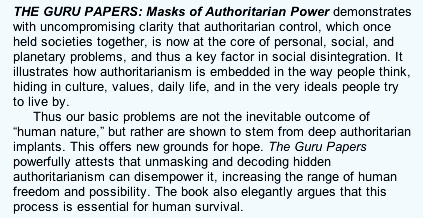
What I have outlined in my paper on 'The Fundamentalist Guru Trap Exploitation' is a very common pattern of behaviour among gurus, which can be seen from studying a fair sample of them. The nature of such authoritarianism has been shown and analysed par excellence by Joel Kramer and Diana Alstad, who have published their findings in a major work, which is also becoming recognised as a key study in authoritarian power and human manipulation both within guru circles and in other organisations throughout society: The Guru Papers and Authoritarian Power
This book was most interesting to me when I found it, after having virtually completed writing all my web pages about guru entrapment and Sathya Sai Baba's abuses of faith and power etc. His entire behaviour is virtually described with clinical accuracy in 'The Guru Papers', though he is not even mentioned there! This alone shows how completely run of the mill his teachings, claims, behaviour and movement are. Kramer and Alstad derived most of their experience from Buddhist teachers, and the similarities to Sathya Sai Baba are very striking throughout. The spiritual claims and behavioural traits typical of authoritarian gurus are highlighted throughout the book. Nothing I have come across shows more clearly how little uniqueness there really is to Sathya Sai Baba or to anything he says or does. His euologised 'teachings' amount to little more than the reproduction - including the direct parroting - of claims made by many former so-called godmen and even current gurus, in whole or in part, and often he descends to vague talk and simplistic and wholly untrue, fantastic or superstitious explanations.
THE PROBLEM OF NARCISSISM
"Gurus become totally attached to the power and privileges of their elevated position." (ibid p. 113) Anyone who needs to be worshipped constantly is subject to an acute form of self-indulgence which comes of narcissism, as is pointed out excellently in 'The Guru Papers'. The need for attention, recognition, unconditional love and adulation is self-interest of a kind that will make the guru eventually make any compromise to remain the centre of admiration. These persons do have attractive powers, charm, charisma and often also psychic abilities beyond the ordinary. Once they get their ball rolling, so to speak, their circle attract others to them through praise for this or that kind of ability to heal, do miracles, know the past and destiny of anyone and be able to grant divine blessing and boons in the hereafter. This constant affirmation from all around the guru becomes like a powerful addictive drug, which is a dependency on the intense exhilaration of personal fame, stardom and deification. This is the other side of the guru trap, the trapper is entrapped and is less able to renounce the fruits or sacrifice his own drug than anyone. They are hooked on keeping those they have themselves hooked. Sathya Sai Baba once said in a discourse that he is 'the prisoner of his devotees'. There is more truth in that than he probably realises, and it is a well-known phenomenon among the high and mighty and the dictators of this world.AUTHORITY AND POWER
Kramer and Alsted write: "we deepened our understanding of how authoritarianism in its varied guises has been and largely still is a primary mode of social cohesion - and also how it became a major factor in social disintegration." (p. xi) They hold that, when power becomes an end in itself, something more important than those under its control, i.e. people and their aspirations etc. that it becomes dangerous power. They view the guru system as a special case of authoritarianism, and most often one which seeks to extend itself through forming cohesive sects and cults. This becomes an end in itself. Religions and gurus promulgate fixed world-views, and are therefore unable to handle change, development, research, inventive discovery or creative solutions.'The Guru Papers' study the guru model as an extreme example of authoritarian power in an overt form where one has to surrender to a living person and so trust another more than oneself, so becoming subject to easy manipulation. As a means to liberating oneself from such programming, they show how it works on a divided psyche through manipulation, control and addiction. The scientific method is rejected in favour of revelation, belief and otherworldly projections and hopes, and one is trained to construct and maintain a view of reality which fits the mould set by the guru. This is self-conditioning to a truth which one accepts as unchallengeable. This stagnant model of truth lies at the root of most authoritarianism.
Authoritarianism goes against self-trust and the creativity arising from it. The guru personality cult's authoritarian control - however subtle and seemingly self-chosen - allows little or no deviance from the limited set ideologies and behaviour patterns. This stops creative persons (including critics!) and favours rigid top-down social organisation of a kind which soon becomes too uniformly repetitive. As one example, this is seen in the constant repetitions by Sai Baba, whose many thousands of discourses go over the same old stories and worn-out moralism again and again, becoming narrower year by year, sounding more like old TV ads which - together with the constant parroting of the creed by followers who cannot invent anything not on the menu - take over the entire channel, as it were.
CONTROL AND MANIPULATION
Kramer and Alsted speak of mental or psychological authoritarianism as coming from "an inner urge to obey someone or something that is viewed as higher, more powerful, morally superior, or more knowledgeable". Everyone knows the prototype of this urge, for it starts with one's dependence on the mother and father - the source of life, happiness, security, knowledge and so forth. The guru often plays the role of substitute mother or father. In the case of Sai Baba, he even claims both roles at once (Sai = Mother, Baba = Father), a Divine hermaphrodite Godhead. So long as one cannot free oneself from this urge, one's independence and personal autonomy suffers very severely, even without one realising the fact.
"Reward and punishment, guilt, shame, and forgiveness - this is the stuff religions use for control. Since it is obvious that the virtuous do not always benefit and sinners do not always suffer, to make this system work it is necessary that the major rewards and punishments take place in an afterlife. This is how immortality (whether heaven or a better next lifetime) became the foundation of morality." (ibid p. 26) Nothing could better encapsulate the main thrust of many religious cults. It encapsulates the whole 'teaching' of Sathya Sai Baba."... the guru can never be wrong make mistakes, or be self-centered, or lose emotional control. He doesn't get angry, he "uses" anger to teach." (ibid p. 53.)
Kramer and Alsted get right to the core of guru entrapment by showing how all gurus appeal to a very human quality, the desire for self-improvement and their respect and desire for selflessness: "Renunciate religions control people through the guilt they instill around self-centeredness..." p. 54 But they extend this to other authoritarian systems, for the same was typical of Soviet and Maoist communism!Another method of manipulation is pretending that the guru's anger is not real anger, because he cannot feel anything negative. But it is simply to teach the devotee that something is wrong, to stop behaving in some way or to behave otherwise. It is punishment. But all said to be for the good of its sufferer. [We have heard that one before from many a disciplinarian and it has become highly suspect as a true motive!] One exchange between a visitor, Dr. John Hislop and Sai Baba shows this:
A Visitor: Baba, since time is simply your will and has no reality outside of that, and duration of time also being your will, why not shorten time a bit? People have so much suffering, why do they have to suffer for so long a time?
Sai: They are being tested, but it should not be called so. It is grace. Those who suffer have my grace. Only through suffering will they be persuaded to turn inward and make the inquiry. And without turning inward and making inquiry, they can never escape misery.H: People have said they are being punished by Swami. Is this a fact?
Sai: Of course. In punishing a person for misdemeanor, Swami punishes in order to correct the defaulter. But, though harsh in appearance and voice, Baba is all love inside. Sometimes Swami corrects a person in private, at other times in public. It depends on the individual. If the correction is in public, then all who hear may learn what pleases Swami and what displeases him. Butter may be cut with a finger, but a rock needs an iron hammer. It all depends on the material, the person. Swami is very strict in his rules and principles. An Avathar does not compromise. To the devotee, strictness is ultimately the best kindness. Depending on the situation, Swami can be soft, kind, or he can be as hard as a diamond. He does not give only one chance, he forgives a thousand times. But if persons still pay no attention, he clips them. (p. 121, 'Conversations with BS Sathya Sai Baba' by Dr. J. Hislop)
Comment: This is exactly the same behaviour used by psychopaths - firstly great charm to attract, usually only with promises and talk, then they give people a shock to keep them in line, at a distance, uncertain. Then - if the 'softening up' process has worked or if the victim seems to be losing interest and faith, they turn on the charm again, or - if in a strong position too, gives an explanation just as above. This push-pull technique is used by all authoritarian manipulators, psychopaths and megalomaniacs.
"... the students often complain that Swami does not talk to them because he is angry with them. I have no anger towards anyone. Whether you believe it or not, I do not know what "
Comment: The sheer chutzpah in supporting an unbelievable claim by "whether you believe it or not" is impressive! It puts the devotee entirely off guard. If you believe it, he may be angry, if not, then one may avoid his anger."I wear only Love glasses. I cannot hate even if I want to. Hate and anger are not part of M; nor is Disease possible for me; I may hiss and warn to correct: but, I never " (page 123, Sathyam Sivam Sundaram Vol 2, by N. Kasturi).
Comment: Can't hate even if he wants to! How would he want that, the pure avathar who doesn't even know what anger means? How then can he know he does not feel it if he doesn't even know what it means. Does he not claim to be all-knowing? He does... but he doesn't know that, yet he had easily and often make himself appear "very angry". Believe him if you want and can... but why not rather believe in yourself and the common sense explanation of his ranting and angry thumping and denouncing of people who dare to criticise him (during his infamous Xmas Discourse, 2000, in his temple - originally translated by Sai students verbatim and posted at <http://www..internety.com/premsai> which site was closed on the order of the Prashanthi Nilayam authorities because of how much it gave away about Sathya Sai Baba's actual words - which are removed in part from the heavily edited and sanitized versions printed in his 'official' journal Sanathana Sarathi)."Sometimes people may feel that Swami is angry and harsh. This is totally wrong. Swami appears to keep aloof from some persons when he feels they are pursuing the wrong paths which may adversely affect their future." p. 185, Sathya Sai Speaks
Comment: The classic guru trick used by hundreds of them since time immemorial. It is for the devotees' sake, not his - of course. This is the hook to hold weak people who are willing to be ruled and cowed when necessary (usually rather often!).ABUSE OF POWER AND SEXUALITY
A penetrating analysis is made in 'The Guru Papers' of 'the seductions of surrender'. Common features of power abuses by 'saints' or gurus are described, and they are virtual descriptions of such abuses practiced by a long list of Evangelist preachers, Indian gurus, without any being named. Pretending celibacy or 'purity' while engaging in sexual activity in secret is a common result of guru power. Power abusers also exploit people so as to consolidate power and this can mean abuse of faith through lies and double standards, and not least sexual abuse of followers. To do this on any scale the guru needs the complicity of people around him, who may well be or be inducted into being sexual abusers themselves. Those who try to expose these matters are often subject to slander, defamation and death threats... and not least curses of eternal damnation or the like by the guru, whether private or even in public. Likewise with actual murders, which require for their success a very tightly knit circle of complicit persons. All this has been shown in clinical detail to be the case with Sathya Sai Baba by hundreds of testimonies, papers and web documents by many persons from all over the world. A much greater weight of testimony that has not been committed to the Web, partly because many are afraid to have their painful accounts made public and partly because some wish their testimony to come out via responsible media, the law courts or both.
One measure of the power of dependency on the guru is that so many devotees refuse not only to believe, but even to listen to, anything of this nature - however well-documented or proven... even after decisive proof in court and imprisonment of the guru! The guru will explain it all in vague otherworldly terms and lay what amounts to a curse on anyone who listens to criticism of him, let alone accepts it. This is a very common pattern among many who have been exposed in recent decades.Links to information on 'The Guru Papers'
http://www.factnet.org/Purchase_Books/The_Guru_Papers.htm
http://www.rit.org/reviews/guru_ppr.html