Documents recording V.K. Narasimhan's revelations about the 1993 murders - part two
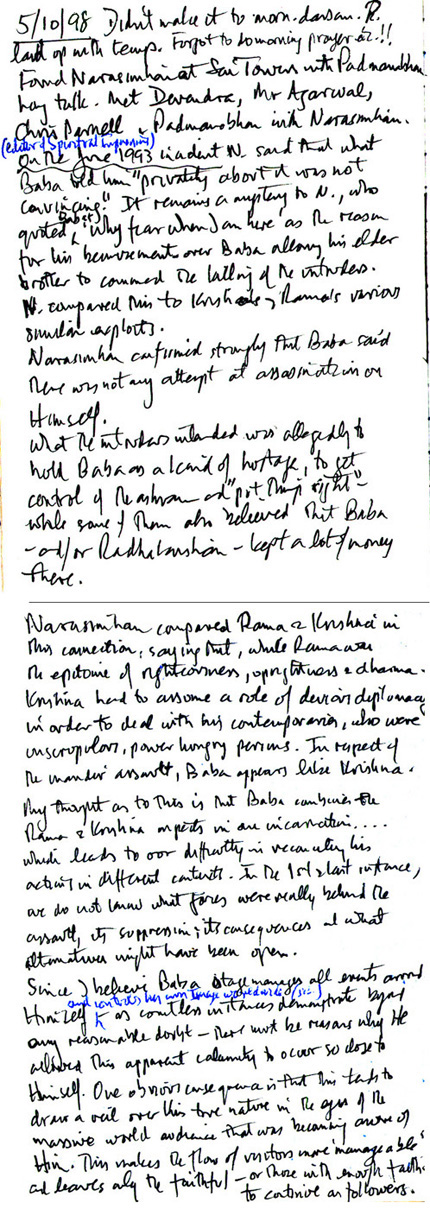
This text is two scanned page excerpts from my notebook of my 1995/6 visit to Prashanthi Nilayam, Puttaparthi, from before the 70th birthday celebrations to after the New Year.
[Due to 'bleed through' of the reverse page ink writing, Contrast and brightness of the scan have been adjusted to make the handwriting as legible as possible]
5/10/1998: Having visited Sai Towers to look in their bookshop, I came across V.K. Narasimhan sitting at a tea table with a group of Sai Towers people, the owner Mr. Padmanabhan, his manager Devendra and his temporary editorial helper from Australia, Chris Parnell (a leader and webmaster in the Sathya Sai Organization there). I was summoned by VKN to join them. V.K. Narasimhan dominated the group totally with his talk, as he always did everywhere among Sai devotees. Various subjects were discussed, not least a reprint of VKN's book 'From Bapu to Baba', for 20 mins. or so until the question of the 1993 murders in Sai Baba's apartments came up (I was not the one to raise the subject).
VKN launched into his doubts about the 'official ashram' version (or versions) of the incident. He said he had asked Swami about different questions arising about it on several occasions but could not get any straight or satisfying answers. No wonder he was worried about the truth of it. He knew very well that the police had been forced by Janakiramiah and others through blackmail to shoot the four devotees who were locked into the apartment (but never mentioned this on this occasion - too dangerous, I am sure) VKN then quoted Sai Baba's famous aphorism: "Why fear when I am here?" and wondered what it could signify after these events.
Transcript of handwritten notes: 5/10/98. Didn't make it to darsan. R. laid up with temp. Forgot to do morning prayer etc.!!
Found Narasimhan at Sai Towers with Padmanabhan. Long talk. Met Devendra, Mr. Agarwal, Chris Parnell (editor of Spiritual Impressions) & Padmanabhan with Narasimhan.
One the June 1993 incident N. said that what Baba told him about it privately in answer to his questions "was not convincing". He repeated this phrase three times! It remains a mystery to N., who quoted Baba's 'Why fear when I am here' as the reason for his bereavement over Baba allowing his elder brother to command the killing of the intruders. N. compared this to Krishna's also Rama's various similar exploits.
Narasimhan confirmed strongly that Baba said there was not any attempt at assassination on Himself.
What the intruders intended was allegedly to hold Baba as a kind of hostage, to get control of the ashram and "put things right" - while some of them also believed that Baba - and/or Radhakrishnan - kept a lot of money there.
Narasimhan compared Rama and Krishna in this connection: saying that, while Rama was the epitome of righteousness, uprightness and dharma, Krishna had to assume the role of devious diplomacy in order to deal with his contemporaries, who were unscrupulous power-hungry persons. In respect of the mandir assault, Baba appears like Krishna. My thought as to this is that Baba combines the Rama and Krishna aspects in one incarnation.... which leads to our difficulty in reconciling his actions in different contexts. [Comment: So naive I was still then, many of the classical Sai indoctrination symptoms!] In the 1st and last instance we do not know what forces really were behind the assault, its suppression; its consequences and what alternatives might have been open.
Since I believe Baba stage manages all events around Himself and controls his own image worldwide (sic) - as countless other instances demonstrate beyond any reasonable doubt - there must be reasons why he allowed this apparent calamity to occur so close to Himself. One obvious consequence is that he tends to draw a veil over His true nature in the eyes of the massive world audience that was becoming aware of Him. This makes the flow of visitors more 'manageable' and leaves only the faithful - or those with enough faith to continue as followers.
-------------------------------------------------------------------------------------
Comment: At this time - 1995 - one can see how I was still strongly inclined to hold Sathya Sai Baba innocent of any wrongdoing. I was rationalising very heavily to find a way out of the difficulties the incident created (along with Narasimhan's inside information about it). Despite my noting that N. said Sai's brother had commanded the killings, I had not reached the degree of doubt about Baba's own involvement that Narasimhan clearly assumed talking to this group. (No one made a single word of comment, except me. Chris Parnell has since made a website to deny that there were any irregularities and the whole matter was cleared up - which he knows full well is untrue!) VKN had not yet then told me the most crushing news - of the way the police were blackmailed by the brother and other Sai officials to execute the four intruders. This he did about 2 months later. At the time I have evidently considered the brother as acting totally independently of Sai Baba, since Sai Baba has since 1940 said his family is of no special significance to him - his family is humanity etc. However, I now see this was obviously posturing (the sannyasin attitude) and that he had very strong family bonds and feelings (he actually shed tears in public when his brother had died!)
Obviously it is an empty slogan, but one which has attracted countless otherwise fearful people to seek his [imaginary] protection. If then a devotee suffers a serious loss, accident, incurable illness or whatever, the rationalization is 'I cannot have been a worthy devotee' or some such self-deceptive mental crutch. Since
Sai Baba has forcefully and repeatedly exclaimed that he always has the interests and protection of all
his devotees at heart why would he let such doubts
as the murders episode created arise? Within ' the holy of holies', the temple building
itself. Why did he not even explain what really occurred or have the matter
investigated properly and cleared up legally? He also ignored all
calls from the press to answer any questions whatever. This silence speaks far louder than all his many moralising words.
That Narasimhan compares Sai Baba and Krishna's unrighteous acts further shows that he took for granted in himself that Sai Baba was unrighteous. (i.e. The Gita records that Krishna
lied to deceive some of his enemies an ambush where they were
killed).
Narasimhan's groping for some kind of explanation only reached the intellectual totally unsatisfactory suggestion that, like Krishna, Sai Baba has had to act occasionally against dharma so as to defeat
the forces of evil ranged against him. In short, even lies and murder
might be necessary to reinstate justice?
When we consider that the four supposed 'evil doers' who were assassinated
were armed only with knives and there is plenty of evidence to show that they were still devoted servants of Sai Baba and probably did
not wish to harm him (as he himself stated), but only to ensure that he removed corrupt
elements who were in control of most of the ashram.
The 'difficulty of reconciling his acts in different contexts' because Sai Baba is supposedly Krishna and Rama in one is truly in the realm of religious fantasy... the kind of straws a devotee tries to grasp to save from drowning in doubts. I noted this down, but even then I was far less than convinced that it had any relevance whatever.
The illogical justification
of murders in this manner is obviously
based more on the despair of threatened faith and comprehensive personal upheaval rather than on holding to righteousness and truth.
Narasimhan had understood that the four followers whose Sai Baba’s
brother and officials had killed by the police were intending to hold Sai Baba
as a hostage and so overthrow those who were misappropriating funds etc. It seems very likely they also wanted to make him stop his sexual molestations (according to circumstantial facts and private reports by frightened village shop owners etc.) By no stretch
of the imagination can they be compared to key causes of the evil in the
world, or whose elimination was essential to
save the 'divine mission' - as Narasimhan's theory would require.
The case of Swiss lady who was slaughtered in her room and whose murderers were allowed to escape by the police, which V.K.N. confirmed to me, was used - he said - to blackmail the police into the executions of the four students trapped in Sai Baba's bedroom. See a letter from a person, Marge Hendel, telling of the original murder incident at the ashram.
A confirmed
believer may try to sustain a fragile peace of mind as a substitute for
facing the facts and recognising the awful truth they imply. VKN had been living close to Sai Baba all the time and evidently trying to figure the matter out in his own mind. One can only imagine what a dilemma, even what a threatening crisis, this must have been for him emotionally and mentally. He had no independent-minded and objective, intelligent persons with whom to confer. Virtually everyone he met was a died-in-the-wool devotee without a critical thought in their heads - indeed, who drove any such thoughts out as devilish... and who it might well have been dangerous for him to tell too much. A former journalist who was now deeply involved in the Sai Baba mission, unable to get answers to burning questions and unable to take the leap of making known to the public what he knew, with all the consequences for himself and his wife (still then alive but ailing greatly).
For these killings to occur - and be condoned in Sai Baba's subsequent silence and covering-up actions - is patent evidence that he is not pure, loving and nonviolent in every possible way. The successful extermination of the intruders silenced them effectively, but the end result is a complete and total fiasco for the "Divine Mission"!
However, my smart idea that Sai Baba needs to draw a veil over his actions to avoid a massive world influx and make the flow of visitors to Prashanthi Nilayam more 'manageable' really amuses me now for it was nothing 'mystical' but an outright cover-up... but also makes me think how much effort I wasted on trying to justify what actually turned out to be totally unjustifiable.